
What Bing AI Means for Publishers Using Bing Webmaster Tools
See what Bing AI means for publishers using Bing Webmaster Tools, from indexing and IndexNow to citation tracking and measurable audience growth.

Bing AI changes what publishers need to measure, but it does not make Bing Webmaster Tools obsolete. A page can be crawled, indexed and visible in conventional search without becoming a cited source in an AI-generated answer. Equally, a citation can expose readers to your reporting without producing a website visit.
For publishers, the practical response is to separate discovery, citation and audience value. Use Bing Webmaster Tools to investigate the parts it can show, then connect those findings with citation checks and first-party analytics. The goal is not simply to appear in more answers. It is to understand which publishing and technical improvements produce useful visibility.
What Bing AI changes for publishers
The name originally associated with Bing’s conversational search now overlaps with Microsoft Copilot and AI-assisted search experiences. These experiences are related, but publishers should not treat every Microsoft search interface as an identical distribution channel.
Bing’s search infrastructure matters to web discovery across Microsoft search experiences. However, appearing in its index is not a guarantee that a page will be selected, quoted or linked in a particular generated response.
That distinction creates three separate editorial questions:
- Can the system discover the page? This involves crawling, indexing, internal links and technical accessibility.
- Does the page offer useful evidence? This involves relevance, original information, clear attribution and current facts.
- Does the exposure help the publication? This involves referral visits, subscriptions, registrations or other defined outcomes.
Bing Webmaster Tools is most directly useful for investigating the first question and search performance. AI-specific reporting, where available, adds another view, but no single dashboard explains the entire path from publication to audience growth.
Match each question to the right evidence
Before changing your content, decide which signal would demonstrate progress. Otherwise, an increase in impressions can easily be mistaken for an increase in citations or engaged readers.
| Publisher question | Useful evidence | What it does not establish |
|---|---|---|
| Can Bing access this article? | URL inspection, crawl diagnostics and server responses | That the article will be indexed or cited |
| Has Bing indexed the intended URL? | Index information and canonical checks | That every AI experience can or will retrieve it |
| Is the page visible in reported search results? | Search Performance data, interpreted using its stated coverage | A complete count of AI citations |
| Is an answer citing the publication? | Dedicated citation reporting where available and recorded answer checks | That a reader clicked the citation |
| Are referred readers valuable? | Analytics events, subscriptions and other audience outcomes | The value of every unclicked brand exposure |
For Bing AI measurement, keeping these distinctions intact matters more than creating a single visibility score. Different signals can move in different directions without contradicting one another.
Establish a Bing Webmaster Tools baseline
Check the exact URLs that matter
Start with a small group of commercially or editorially important pages, rather than trying to diagnose the entire publication at once. Include a recent story, an evergreen explainer, a recently updated article and an important section page.
In Bing Webmaster Tools, inspect the intended canonical URLs and review the indexing and crawl information available for them. Compare those findings with the live page, its HTTP status, robots directives and canonical tag.
Look for mismatches. A story might link internally to a redirected URL, declare a different canonical or depend on rendering that makes its main text difficult to retrieve. These are discoverability problems, not evidence that an AI system dislikes the article.
Separate technical faults from editorial gaps
Review sitemap processing and crawl diagnostics before rewriting content. A submitted sitemap helps communicate URLs, but submission alone does not establish indexing.
Next, examine the page and query data available in Search Performance. Compare equivalent periods and note publication dates, major updates, redirects and seasonal demand. A news article naturally losing attention is different from an evergreen page becoming inaccessible.
A Bing AI investigation should begin with this evidence, not with adding question headings to every article. If several important pages share a technical fault, resolving that fault deserves priority over isolated copy changes. For a broader implementation review, use the AI SEO crawl audit checklist for publishers alongside your Bing-specific findings.
Help Bing discover meaningful publishing changes
Publishers have a freshness problem that static business websites often do not: facts change, stories develop and outdated information can remain accessible under several URLs.
Keep XML sitemaps aligned with the canonical pages you want discovered. Use accurate modification dates when substantive content changes, rather than updating every timestamp automatically. Maintain working internal links from relevant sections and related coverage so discovery does not depend on a single submission mechanism.
IndexNow provides a way to notify participating search engines when URLs are added, updated or deleted. It is a notification mechanism, not a promise of immediate crawling, indexing or inclusion in an answer.
For Bing AI visibility, the useful objective is to reduce avoidable delays between a meaningful editorial change and its discovery. Send notifications for real changes, preserve clear correction notes and make sure the updated facts appear in the retrievable page text.
Make articles useful as sources, not just search results
An AI answer may need one reliable passage rather than the full narrative arc of a feature. Publishers can support that use without turning every story into a generic FAQ.
Place the central finding, definition or practical answer where a reader can locate it. Then provide the evidence and limitations nearby. If a number depends on a particular sample, region or reporting period, keep that qualification with the number rather than several paragraphs away.
Strong source passages typically include a clear subject, a specific claim and enough context to interpret it. Original interviews, documented methodology and accessible source material give a publication something more useful to contribute than a summary of other summaries.
For example, an article about local housing costs should distinguish asking rents from signed leases and identify the period covered. A concise paragraph that preserves those distinctions is more useful than an isolated headline figure.
Bing AI optimization should not mean making unsupported claims more quotable. Preserve editorial nuance, identify authors and reviewers where appropriate, and use structured data only when it accurately describes the visible page. Markup is not a substitute for evidence or a guarantee of citation.
Measure citations separately from search traffic
Read the reporting scope before interpreting the numbers
Use any dedicated AI citation report available in your Bing Webmaster Tools account, but check its definitions and coverage before building a scorecard around it. Determine what constitutes a citation, which experiences are covered and what reporting window applies.
Apply the same discipline to Search Performance. Do not assume its clicks and impressions represent every Copilot experience, or that AI-related appearances are necessarily excluded. Interpret the report according to Microsoft’s current documentation and the labels shown in your account.
For Bing AI analysis, a source appearance, a citation link and a referral visit are different events. Even when two reports concern the same page, their totals may not be directly comparable.
Use repeatable answer checks as a supplement
Create a manageable set of audience questions connected to your selected pages. Include factual questions, comparisons and questions that require recent information where those fit your coverage.
For each check, record the exact question, date, interface, relevant location or language settings, cited URLs and whether the cited passage supports the answer. Keep a screenshot or other record so another editor can review the observation.
These checks are a sample, not a complete measurement system. Answers can change with wording, timing and context. A single missing citation does not establish a penalty, just as one successful appearance does not establish durable visibility.
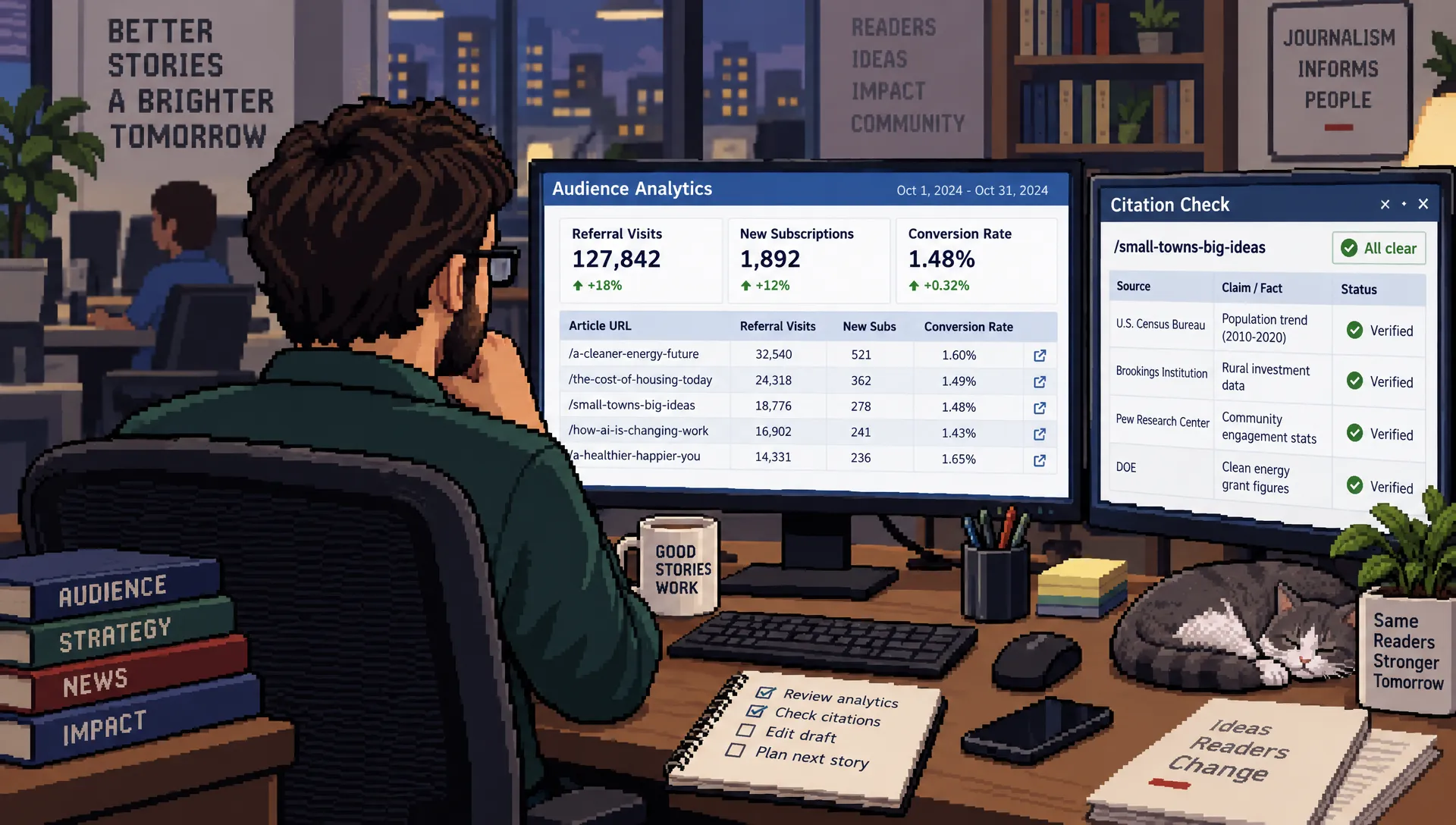
Connect referred visits to a useful next step
A citation creates an opportunity only if the destination page serves the arriving reader. Someone following a link to a specific finding should land on a page that explains it clearly, loads reliably and makes the publication’s next relevant offer easy to understand.
For a news publisher, that might be a related newsletter. For a professional publication, it could be a research download or event registration. Choose the action according to the page’s purpose rather than placing the same subscription prompt everywhere.
Publishers that also sell services may use an on-site AI chatbot grounded in verified business information to handle routine visitor questions. That belongs to the on-site conversion layer. It does not submit articles to Bing or create a citation advantage.
Evaluate Bing AI referrals using identifiable traffic and meaningful outcomes, while recognizing that referral attribution can be incomplete. This guide to assessing whether AI search sends qualified traffic provides a framework for separating visits from actual audience value.
Run a focused 30-day publishing test
A short test can reveal implementation problems and useful patterns, although it cannot prove how an AI ranking system works. Select a manageable cohort of pages with a shared audience need. Keep a comparable group unchanged where practical, and document differences in topic, age and demand.
Use a simple sequence:
- Week 1, establish the baseline: Record indexing findings, reported search performance, observed citations and relevant audience outcomes.
- Week 2, implement specific changes: Fix verified technical faults or improve source passages. Avoid combining a redesign, URL migration and editorial rewrite in the same test.
- Week 3, verify discovery: Recheck important URLs, sitemap processing and update notifications. Record when changes become observable rather than assuming submission means processing.
- Week 4, review the evidence: Compare results with the baseline and unchanged pages, noting news cycles, seasonal demand and other competing explanations.
For Bing AI testing, write down the hypothesis before making changes. “Adding the survey methodology will make this finding easier to verify” is testable editorial reasoning. “Adding more keywords will make Copilot cite us” is an unsupported assumption.
Keep improvements that benefit readers even when citation changes remain inconclusive. Clear sourcing, accurate corrections and working canonical URLs have value beyond one answer interface.
Set access and reuse policies deliberately
Publishers may want broad search discovery while limiting certain forms of reuse. Those goals require a policy decision, not an improvised robots.txt edit.
Review Bing’s documentation on supported robots directives before changing controls that affect indexing, snippets or content use. Do not assume that blocking one crawler controls every Microsoft experience, or that a training restriction necessarily governs retrieval at answer time.
Also distinguish crawl blocking from removal. Preventing a crawler from fetching a URL is not a reliable way to remove an already indexed page, and it can stop the crawler from seeing page-level directives.
Assign ownership across editorial, audience and engineering teams. A restriction introduced for one purpose should not silently undermine the publication’s agreed discovery strategy.
Frequently asked questions
Does being indexed by Bing guarantee a Copilot citation? No. Indexing and source selection are separate steps. An indexed page may be eligible for discovery without being selected for a particular answer, and different Microsoft experiences can handle sources differently.
Can Bing Webmaster Tools show every AI citation? Do not assume complete coverage. Check the scope of any AI-specific report available in your account. Combine that evidence with repeatable answer checks and analytics, while keeping each dataset’s limitations visible.
Does IndexNow improve rankings? IndexNow notifies participating search engines about URL changes. It does not guarantee crawling, indexing, ranking improvements or inclusion in an AI answer. Its practical role is communicating changes efficiently.
Do publishers need special schema for Bing AI? There is no universal schema markup that guarantees citation. Use supported structured data accurately, maintain accessible article text and focus on clear claims, reliable sourcing and relevant original information.
Choose one publishing workflow to improve
Start with a small page cohort and a single documented problem: delayed discovery, unclear source passages or poor conversion after referral. Establish the baseline before changing the workflow. For the broader cross-platform context, use Search Optimization’s AI SEO strategy guide, then measure Bing-specific results on their own terms.
Read more

How Retailers Can Prepare Product Data for the OpenAI Search Engine
AI shopping answers are only as reliable as the product records behind them. Learn how to align variants, pricing, availability and merchant feeds so shoppers get useful recommendations instead of stale or misleading details.

How the Google AI Search Engine Displays Links and Citations
A link beside an AI answer is not always evidence for every claim. Learn where Google places source links, how AI Overviews differ from AI Mode and what publishers can actually measure.

How OpenAI Search Handles Paywalls and Subscriber Content
A paywalled article can appear in an AI answer without its full text being available. Learn how citations, publisher agreements and crawler controls differ, then protect subscriber content without hiding every useful preview.