
Is AI Search Sending Your Website Qualified Traffic?
Is AI search sending qualified visitors? Track referrals, compare lead quality and connect traffic to pipeline without overclaiming attribution.

AI search can send visitors who already understand your product, recognize their problem and arrive ready to compare options. It can also send curious readers, poor-fit prospects or almost no measurable traffic at all. A citation alone does not tell you which outcome you are getting.
The useful question is not whether an assistant mentioned your website. It is whether the resulting visits produce customers, qualified leads or another outcome your business values. Answering that requires a clear definition of quality, careful attribution and a comparison that goes beyond engagement rate.
Define “qualified” before inspecting referrals
A qualified visitor has a plausible reason to become a customer and takes actions consistent with that intent. The definition depends on your business model, not the platform that sent the visit.
For a B2B software company, qualification might mean a demo request from a business that matches its target market. For an online store, it might mean a purchase with an acceptable margin and return rate. A publisher might prioritize paid subscriptions rather than page views.
Use a short measurement hierarchy:
Audience fit: The visitor or account matches your supported market, customer profile or use case.
Meaningful action: They request a demo, start a relevant trial, purchase or complete another valuable action.
Validated quality: Sales accepts the lead, the trial activates or the order remains valid after cancellations and returns.
Business value: The visit contributes to pipeline, revenue or retained customers.
A useful test for AI search is whether it improves these outcomes, not whether its visitors spend longer on the site. A five-minute visit can indicate interest, but it can also mean someone struggled to find an answer.
Use this framework alongside your broader search performance metrics beyond rankings, rather than creating a separate definition of success for one channel.
Separate observable visits from untracked influence
Referrals you can identify
Start with the referring sources actually present in your analytics. Depending on how visitors access an assistant, you may see domains such as chatgpt.com, perplexity.ai, claude.ai, copilot.microsoft.com or gemini.google.com.
Treat these as examples to investigate, not a complete or permanent classification list. Inspect the source, medium and landing page before including a domain in your reporting group. Confirm that the traffic is genuine and apply your normal internal-traffic and bot controls.
For AI search attribution, the defensible label is identifiable assistant referrals. It describes the subset you can observe without implying that you have measured every visit influenced by an AI-generated answer.
Record the source definitions you use and review them periodically. Otherwise, a newly recognized domain can create an apparent traffic increase that is really a reporting change.
Google features and missing referrers
Google's AI-generated search features need separate treatment. Google's documentation on AI features and website visibility explains that traffic from features such as AI Overviews and AI Mode is included in Search Console's overall Web search reporting. Do not assume ordinary Google organic sessions can be reliably separated into AI-generated and conventional-result clicks using a referral-domain rule.
Other journeys are also difficult to observe. Someone may discover your brand in an assistant, search for it later and arrive through branded organic traffic. Another person may copy a URL or use an app that does not preserve a referrer.
These gaps do not make measurement useless. They limit the claim you can make: a referral report shows attributable visits, not the channel's complete influence.
Keep self-reported discovery answers, branded-search changes and citation monitoring as supporting evidence. None proves the source of an individual conversion by itself.
Build an AI search traffic report you can defend
Keep acquisition scope consistent
In GA4, use session-scoped acquisition dimensions, such as Session source / medium, when asking which sources brought visits during a reporting period. Do not mix that question with first-user acquisition, which describes how users were originally acquired.
Create a saved report, exploration or documented reporting group using verified source values. Preserve the individual source rows so you can see whether one platform accounts for most of the results.
Include the reporting dates, landing pages and geography. Review device and new-versus-returning visitor differences when they could explain performance. For example, comparing mostly desktop referrals with a mobile-heavy baseline can conceal a device-related conversion gap.
Also label the attribution basis. A session-source conversion report, a first-touch CRM report and a revenue report using an attribution model answer different questions. They should not be presented as interchangeable totals.
Connect visits to validated outcomes
A useful AI search report follows the visitor beyond the initial form submission. Where your systems and consent arrangements permit, reconcile analytics with CRM, trial or order outcomes using approved identifiers. Do not send names, email addresses or other prohibited personally identifiable information to Google Analytics.
| Metric | What it helps establish | Main limitation |
|---|---|---|
| Identifiable referral sessions | Observable traffic volume | Misses visits without a usable referrer |
| Engaged-session rate | Whether visitors interact with the site | Does not establish customer fit |
| Sessions with a meaningful conversion | Whether visits produce a target action | Depends on the action being configured correctly |
| Qualified leads or valid orders | Whether conversions meet business criteria | Requires downstream validation |
| Opportunities or realized revenue | Commercial contribution | Needs sufficient time and consistent attribution |
Calculate qualification consistently. For a lead-generation site, one useful measure is:
Qualified-lead rate = unique qualified leads attributed to the cohort ÷ sessions in that cohort × 100.
Deduplicate leads and make the attribution rule explicit. If opportunities take months to develop, compare cohorts at the same age rather than treating an immature cohort as a failure.
Compare similar audiences, not just channel averages
An assistant referral landing on a pricing page should not be judged only against all organic traffic, including thousands of visits to broad educational articles.
Start with comparable landing pages and intent. Then examine relevant differences in country, device, customer eligibility and reporting period. You may not have enough data to match every variable, but you should identify the largest sources of bias.
The following example is hypothetical, not an industry benchmark:
| Outcome | Identifiable assistant referrals | Comparable organic-search cohort |
|---|---|---|
| Sessions | 400 | 4,000 |
| Demo submissions | 16 | 120 |
| Sales-qualified leads | 8 | 40 |
| Demo submission rate | 4.0% | 3.0% |
| Qualified-lead rate | 2.0% | 1.0% |
| Share of submissions qualified | 50.0% | 33.3% |
Here, AI search referrals produce a higher qualified-lead rate, but the comparison cohort still generates five times as many qualified leads. Both findings matter: one suggests promising visitor quality, while the other shows where most current volume comes from.
Eight qualified leads are not enough to declare a permanent advantage. Display the underlying counts, repeat the comparison across periods and use uncertainty intervals when the decision warrants statistical analysis.
Avoid adopting a universal minimum sample size. The evidence needed depends on conversion frequency, variation and how costly a mistaken investment would be.
Inspect the journey from recommendation to landing page
Traffic quality depends partly on what the assistant led someone to expect. A highly relevant recommendation can still produce a poor visit if the destination page does not answer the next question.
Review the landing pages receiving identifiable referrals. Can a visitor quickly understand who the offer serves, what it does and what to do next? Are pricing conditions, eligibility limits and product capabilities stated accurately?
For AI search visitors, the next task may be validation rather than discovery. They may arrive looking for evidence behind a recommendation, a specific integration, implementation requirements or a comparison with an alternative.
Use page-path analysis, on-site search terms, consented session research and sales feedback to identify friction. Session recordings cannot tell you what an assistant said before the visit, so do not infer a prompt from on-site behavior alone.
If buyers mention an inaccurate recommendation, document the mismatch. Correct unclear statements on your own pages and review whether accessible documentation supports the claim. A screenshot of one answer is useful evidence of that instance, not proof of how a platform always describes your business.
Diagnose the result before changing your strategy
Strong qualification, limited volume
A small source can be commercially useful without being a major acquisition channel. If referred visitors consistently match your audience and become customers, preserve what works and investigate which pages attract them.
Do not assume that publishing more content will scale AI search traffic proportionally. Identify the relevant questions and page types first, then test additional coverage where your business has useful evidence or expertise.
Allocate effort according to incremental value and the cost of production, maintenance and measurement. A promising conversion rate is not permission to ignore acquisition costs.
Plenty of visits, weak customer fit
High traffic with low qualification often calls for closer inspection of positioning and audience expectations. Your content may answer a popular question that has little connection to your paid offering, or visitors may be seeking a feature you do not provide.
Segment the results by landing page and observable source before rewriting everything. One broad informational article can distort an otherwise useful referral cohort.
Make eligibility, service area and product limitations easy to find. The goal is not to persuade every visitor to convert. It is to help suitable prospects proceed and unsuitable prospects recognize the mismatch.
Better engagement, no downstream improvement
Longer visits and more page views are supporting signals, not proof of commercial value. GA4's engagement documentation describes an interaction-based metric, not a measure of buyer suitability.
If AI search referrals show stronger engagement but no improvement in qualified outcomes, inspect the conversion path. Visitors may need clearer evidence, a more relevant offer or a simpler next step.
Also check measurement before changing content. Broken forms, duplicate events, incomplete CRM source capture or inconsistent qualification rules can produce misleading conclusions. Where the downstream results remain weak after those checks, report the channel as engaging but not yet commercially validated.
Run a focused 30-day evaluation
Thirty days can establish a baseline and reveal tracking problems. It cannot guarantee enough conversions or a complete view of a long sales cycle.
Keep the initial evaluation narrow:
Define the cohort: Document verified referral sources, exclusions and your attribution basis.
Choose one primary outcome: Use qualified leads, activated trials, valid purchases or another outcome tied to business value.
Select a comparison: Use similar landing-page intent and account for major audience differences.
Test one meaningful improvement: Address a documented landing-page mismatch, missing proof or conversion obstacle.
Keep a change log and avoid bundling several major edits into one test. If traffic is too sparse for a controlled experiment, describe the work as an observational evaluation rather than claiming causation.
At the end, summarize identifiable visits, validated outcomes, cohort maturity and the next decision. Continue tracking delayed outcomes after the initial window closes.
Your conclusion about AI search should be specific: “These identifiable referrals produced six accepted leads from relevant accounts” is more useful than “AI visitors are high intent.” It tells the business what happened and leaves room for the evidence to change.
Frequently asked questions
Can GA4 identify every visitor influenced by an AI assistant? No. It can identify visits with usable acquisition information, including some assistant referrals. Missing referrers, later branded searches and cross-device journeys leave gaps. Report observable referrals separately from broader evidence of influence.
Does a citation mean my website received traffic? No. A user can see your brand or a cited page without clicking. Citation visibility, referral sessions and qualified conversions are separate measurements and should remain separate in reporting.
What conversion rate should I expect? There is no universal rate that establishes quality. Your audience, landing pages, offer and conversion definition all affect the result. Compare qualified outcomes against a relevant baseline and show the counts behind every rate.
How can I tell whether AI search traffic is better than organic traffic? Compare similarly defined cohorts using qualified-lead rate, valid purchases or downstream revenue. Account for landing-page intent and cohort maturity. A higher rate can indicate better performance for that cohort, but it does not establish greater total contribution or prove the source caused the difference.
Turn the findings into a bounded investment
Start with the referral data you can verify, connect it to a meaningful business outcome and improve one part of the journey. Scale effort when the evidence supports it, not simply because citation counts rise.
When you are ready to work on visibility, use a platform-specific optimization strategy to guide execution. Keep the investment tied to validated customer outcomes rather than mentions alone.
Read more

How to Use AI Content Optimization to Refresh Old Articles
Old articles need more than a new date and a quick rewrite. Learn how to prioritize the right pages, use AI to find meaningful gaps and publish updates you can verify and measure.
How Google AI Search Changes the Customer Journey
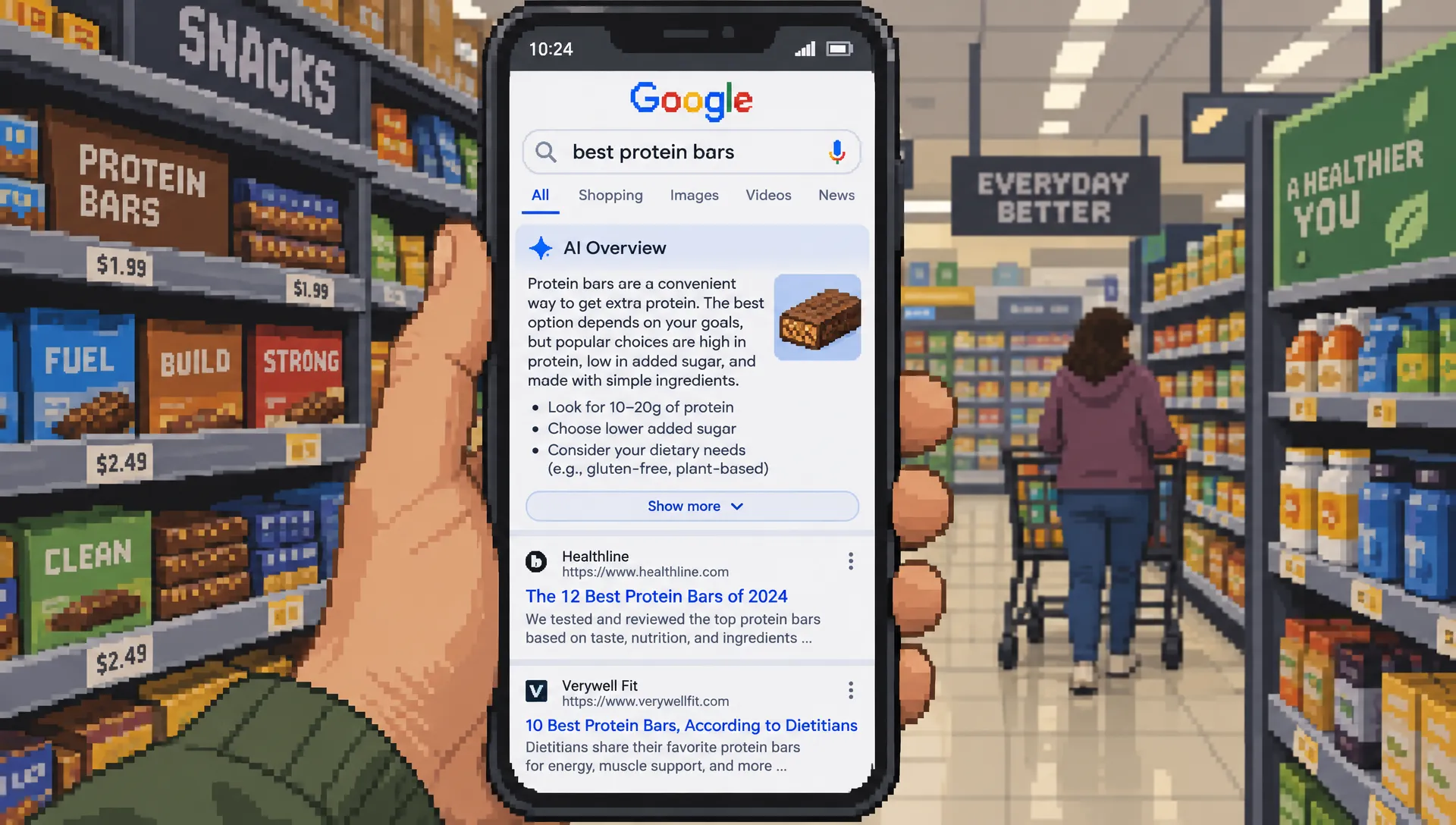
Customers can compare options and form a shortlist before they reach your website. Learn where Google’s AI experiences change that journey and how to create content, proof and conversion paths that support the next decision.

Search Optimization Metrics That Matter Beyond Rankings
A higher ranking can hide weaker traffic and fewer customers. Learn which metrics connect organic search and AI citations to qualified visits, conversions and revenue, plus how to build a scorecard that supports better decisions.