
How Retailers Can Prepare Product Data for the OpenAI Search Engine
Prepare product data for the OpenAI search engine with clear variants, accurate prices, structured data and a practical retail QA workflow.

Preparing product data for the OpenAI search engine starts with a practical task: making every product easy to identify, compare and verify. Retailers need consistent identifiers, clear variant information, current prices and availability that agrees across product pages, structured data and any supported merchant feed. More promotional copy will not fix conflicting records.
This guide focuses on that data foundation. It explains what to publish, how to keep it synchronized and how to test whether shopping answers represent your products accurately, without assuming that technical eligibility guarantees a recommendation.
How product discovery in ChatGPT works
“OpenAI search engine” is commonly used to describe ChatGPT’s search experience. For retailers, the relevant distinction is between an answer drawing on web sources and a shopping experience displaying structured product information. These can involve different presentation and data pathways.
A shopper might ask for waterproof walking shoes, then narrow the request to a particular size, budget and delivery destination. Your catalog needs to support those constraints individually. A page saying “perfect for every adventure” provides less useful evidence than explicit information about waterproof construction, fit and available sizes.
Source attribution also needs careful interpretation. A citation to your website does not establish that every detail in the answer came from your latest product record. Our explanation of how generative AI search engines select sources distinguishes retrieval, influence and visible attribution, which are separate outcomes.
Build a reliable product record for the OpenAI search engine
Start with a master record that your ecommerce platform, product pages and feeds can share. This might live in a product information management system or another catalog database. The essential requirement is clear ownership of each field, not a particular software stack.
Use this as an internal preparation checklist, not as an official OpenAI feed specification:
| Data area | Information to maintain | Error to prevent |
|---|---|---|
| Product identity | Brand, product name, SKU and genuine GTIN or MPN where applicable | Different products being treated as interchangeable |
| Variant identity | Parent relationship, size, color, material and variant URL | A recommendation pointing to the wrong configuration |
| Offer | Price, currency, condition and applicable promotion dates | An expired or inapplicable price appearing current |
| Inventory | Availability for the specific variant and market | An unavailable size appearing purchasable |
| Specifications | Dimensions, weight, compatibility and supported use cases | A recommendation based on missing constraints |
| Purchase terms | Shipping destinations, delivery conditions and return policy | A product appearing suitable when fulfillment is unavailable |
Never manufacture identifiers to fill empty fields. An internal SKU is not a substitute for a valid GTIN.
Assign responsibility for changes. Merchandising may own descriptions, inventory systems may own stock and pricing systems may own offers. Without those boundaries, manual edits can leave several conflicting versions of the same product in circulation.
Describe variants as distinct shopping choices
For the OpenAI search engine, useful product data must resolve the shopper’s constraints at the variant level. A parent product being in stock does not mean that every size and color is available.
Consider this hypothetical catalog entry:
Weak description: “TrailRunner Pro shoes. Comfortable, durable and available in multiple options.”
More useful description: “TrailRunner Pro waterproof trail shoe, women’s US size 8, wide fit, blue. Synthetic upper, rubber outsole and manufacturer-specified weight of 290 g per shoe in the reference size.”
The second version supports comparisons, but only if those details are true. State which reference size a weight applies to and avoid presenting one variant’s measurements as universal.
Keep model names, compatibility information and units consistent. If a charger supports a particular connector and power standard, record those separately rather than collapsing them into “works with most devices.” For furniture, distinguish assembled dimensions from package dimensions.
Variant URLs should open the relevant selection when your platform supports it. Canonicalization should reflect your indexing strategy, but it should not prevent a shopper from reaching the exact configuration being described. A recommendation for a blue, wide-fit shoe should not land on a page that silently defaults to a different variant.
Align product pages, structured data and merchant feeds
Preparation for the OpenAI search engine is a consistency exercise across publishing surfaces. Each surface should describe the same product and offer, even when its format differs.
The public product page should expose essential facts in accessible text. Do not make price, compatibility or availability understandable only through an image, an account login or an interaction that a crawler may not complete.
Use relevant Product and Offer structured data to express information that also appears on the page. Price, currency, condition and availability should agree with the shopper-visible offer. Structured data helps describe a product; it does not guarantee inclusion or citation.
Where a supported merchant submission route is available, map the master record to its documented requirements. Consult OpenAI’s merchant information for current access and submission guidance. Do not assume that an existing Google Merchant Center feed is automatically submitted to or accepted by OpenAI.
Keep platform-specific transformations separate from the master record. One channel may require particular availability values or image specifications, while another uses different conventions. Validate the exported result rather than assuming that a successful database update means every downstream system received it.
Check crawl access without confusing it with training permission
For web discovery through the OpenAI search engine, review crawler access separately from feed submission. A valid feed does not establish that your public pages are accessible, and accessible pages do not establish feed acceptance.
OpenAI documents OAI-SearchBot for search-related crawling and GPTBot for potential model-training use. These are distinct controls. Check OpenAI’s crawler documentation before changing robots.txt or firewall rules, since crawler details can change.
Inspect actual responses to product URLs. A browser returning a normal page does not prove that a crawler avoids a challenge page, regional redirect or blocked resource. Use server logs and verified crawler information rather than trusting a user-agent string alone.
Discovery also depends on site architecture. Connect important products through useful categories and maintain clean sitemaps. Our guide to ecommerce category-page optimization covers category intent and crawlable URL management in more detail.
Put boundaries around health and safety claims
Some catalog attributes need stricter review than ordinary marketing copy. Supplements, health devices, protective equipment and children’s products can become misleading when a qualification disappears from a summary.
Keep intended use, supporting evidence, warnings and limitations close to the relevant claim. Distinguish “compatible with” from “certified for,” and do not turn a customer’s experience into a verified product outcome.
For a wellness retailer, adjacent resources need accurate labels too. For example, free online health screening quizzes provide indicative screening results rather than diagnoses. That distinction illustrates the same discipline your catalog needs: identify what something does, what it does not establish and when professional advice is appropriate.
Store material limitations in structured fields where practical, then surface them in readable page content. A warning buried in an image or unrelated policy page is easier to miss when product information is summarized.
Set freshness rules for prices and inventory
Accuracy in the OpenAI search engine depends partly on timing, but retailers control only part of that process. You can update your pages and submissions promptly; you cannot promise when an external system will retrieve or refresh them.
Prioritize fields by how quickly they change and how much harm an error causes. Flash-sale prices, scarce inventory and delivery promises need tighter internal update targets than material descriptions or care instructions.
Define what happens when a promotion ends, a variant sells out or a product is discontinued. The page, structured data and feed should move to the appropriate state together. Avoid leaving a sale price in one output after the checkout price has changed.
For temporary stockouts, preserve useful product information where appropriate and show the status clearly. Do not redirect an unavailable variant to an unrelated product simply to retain traffic.
Location adds another layer. Display currency, delivery eligibility and regional restrictions explicitly. If an offer depends on a destination or customer status, make that condition visible rather than presenting it as universally available. Your own systems should record when each output was generated and whether delivery to the next system succeeded.
Validate the complete shopping journey
Before testing visibility in the OpenAI search engine, confirm that the underlying shopping journey works. A technically valid record can still send shoppers to a mismatched image, an unavailable selection or a different checkout price.
Choose a small but varied test set: a product with many variants, a discounted item, a regional restriction, a temporary stockout and an item with a meaningful compatibility constraint. These cases reveal more than checking only simple, fully stocked products.
For each test item, check:
- Identity: The title, identifiers, images and selected variant describe the same item.
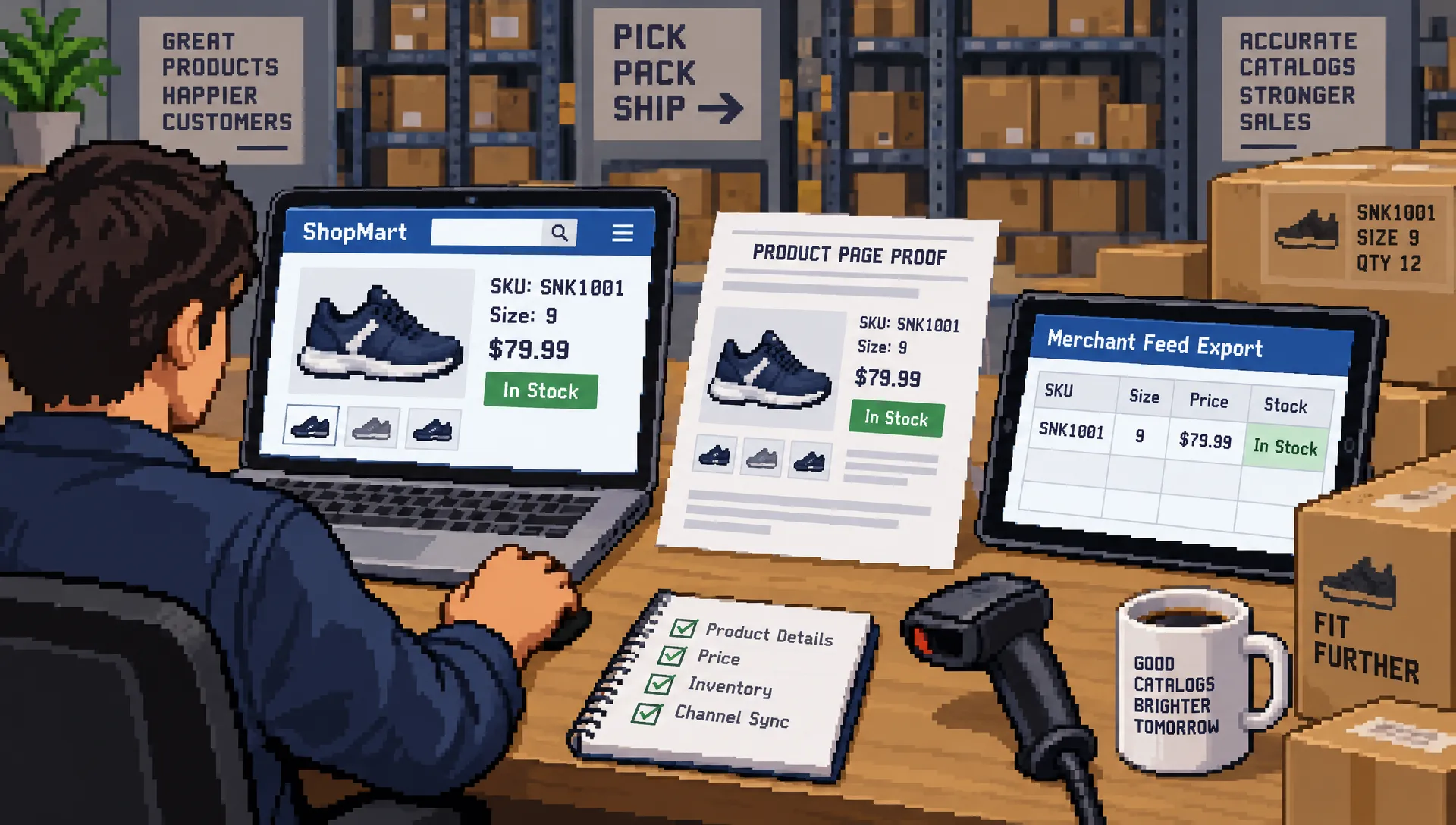
- Offer agreement: Page content, structured data, feed output and checkout agree on the applicable price and availability.
- Destination: The URL resolves successfully and preserves the intended product selection.
- Constraints: Compatibility, shipping restrictions and material limitations remain visible.
- Processing: Submission errors and rejected records reach someone responsible for fixing them.
Save the evidence behind each result. A timestamped page capture, exported record and validation response make discrepancies easier to investigate.
AI can help compare these artifacts, but it should receive the actual evidence rather than infer the state of your catalog. Our workflow for using OpenAI models in SEO audits explains how to keep that review bounded and traceable.
Measure representation, not just mentions
Once the basics work, test how the OpenAI search engine represents your products in realistic shopping conversations. Build prompts from genuine customer requirements, including budget, size, compatibility and delivery destination.
Repeat selected tests and record the date, prompt, answer, cited source and linked destination. Results can vary, so one favorable answer is not evidence of stable visibility. Inspect whether each citation supports the nearby claim and whether the destination still shows the stated offer.
Track operational quality alongside discovery: mismatched offers, rejected feed records, stale availability and incorrect variant destinations. These are problems your team can investigate directly.
Keep reporting categories separate. A product mention, a citation, a referral visit and a completed order are different events. Likewise, a crawler request in server logs does not prove that the product appeared in an answer. Referral reporting may be incomplete, so treat it as one signal rather than a complete account of AI-assisted purchasing.
Frequently asked questions
Does OpenAI have a search engine retailers can optimize for? ChatGPT offers search experiences that can surface web sources and product information. Retailers can improve accessibility and data quality, but there is no universal checklist that guarantees placement or recommendations.
Does the OpenAI search engine require a product feed? Do not treat a feed as a universal requirement for every form of discovery. Public web discovery and supported merchant submissions are different pathways. Check current merchant guidance for your eligibility and submission options.
Will Product schema make ChatGPT recommend my store? No. Accurate structured data can make product information easier to interpret, but it is not a recommendation guarantee. The visible page, offer quality and relevance to the shopper still matter.
Can I block training crawlers while allowing search crawling? OpenAI documents separate crawlers for those purposes. Review its current documentation and verify your implementation. Allowing search crawling does not guarantee inclusion or control how often information refreshes.
Start with one category
Choose a category where variant mistakes or stale offers already create customer friction. Establish reliable records, align every publishing surface and test representative shopping journeys. Expand after the workflow consistently catches errors, rather than exporting the same catalog problems across more products.
Read more

What Bing AI Means for Publishers Using Bing Webmaster Tools
Being indexed is not the same as being cited by an AI answer. Learn how to use Bing Webmaster Tools to diagnose discoverability, separate citations from clicks and test changes against real publishing outcomes.

How the Google AI Search Engine Displays Links and Citations
A link beside an AI answer is not always evidence for every claim. Learn where Google places source links, how AI Overviews differ from AI Mode and what publishers can actually measure.

How OpenAI Search Handles Paywalls and Subscriber Content
A paywalled article can appear in an AI answer without its full text being available. Learn how citations, publisher agreements and crawler controls differ, then protect subscriber content without hiding every useful preview.