
How the Google AI Search Engine Displays Links and Citations
See how Google search engine AI displays links and citations, how AI Overviews differ from AI Mode and what to verify before trusting a source.

Searching for “google search engine ai” can lead to several different experiences, but the key distinction is simple: Google’s generated answer and the pages linked beside it are not the same thing. AI Overviews summarize information within search results. AI Mode supports a more conversational search experience. Both can display links, but those links do not necessarily support every sentence in the answer.
For readers, the challenge is finding the page behind a claim. For publishers, it is distinguishing a genuine source citation from an ordinary result, a brand mention or another link on the screen.
Start by separating the answer from the results
A Google results page can contain several layers: generated text, conventional ranked results, advertisements and specialized modules such as shopping or local listings. Their proximity does not make them interchangeable.
An AI Overview is a generated response embedded in the search results experience. Standard web results can still appear elsewhere on that page. AI Mode organizes the experience around an AI response and follow-up questions, with links available within or alongside the response.
Neither should be confused with the standalone Gemini app. Although Google uses Gemini models in its AI search features, the interfaces and surrounding search functionality differ.
The practical rule is to identify which component contains a link before deciding what that link represents.
How Google search engine AI displays source links
There is no single permanent citation layout. Google changes interfaces, tests designs and adapts presentation to the device and query. The following are useful categories for understanding what you see, not a promise that every search will display every format.
| Visible element | What it usually represents | What to check |
|---|---|---|
| Source marker near generated text | Access to one or more associated sources | Whether it opens a source panel or goes directly to a page |
| Linked source card | A web page presented with identifying information, such as its title or site name | The destination URL and the passage supporting the answer |
| Source panel or grouped links | Several pages associated with the response or part of it | Which claim each page actually supports |
| Standard web result | A separately ranked search result | Whether it is also cited within the AI response |
| Unlinked brand or publication name | A textual mention | Whether any clickable attribution exists |
A visible title or favicon helps identify a destination. Neither establishes that the page is authoritative, current or correctly represented.
Inline markers and source cards serve different purposes
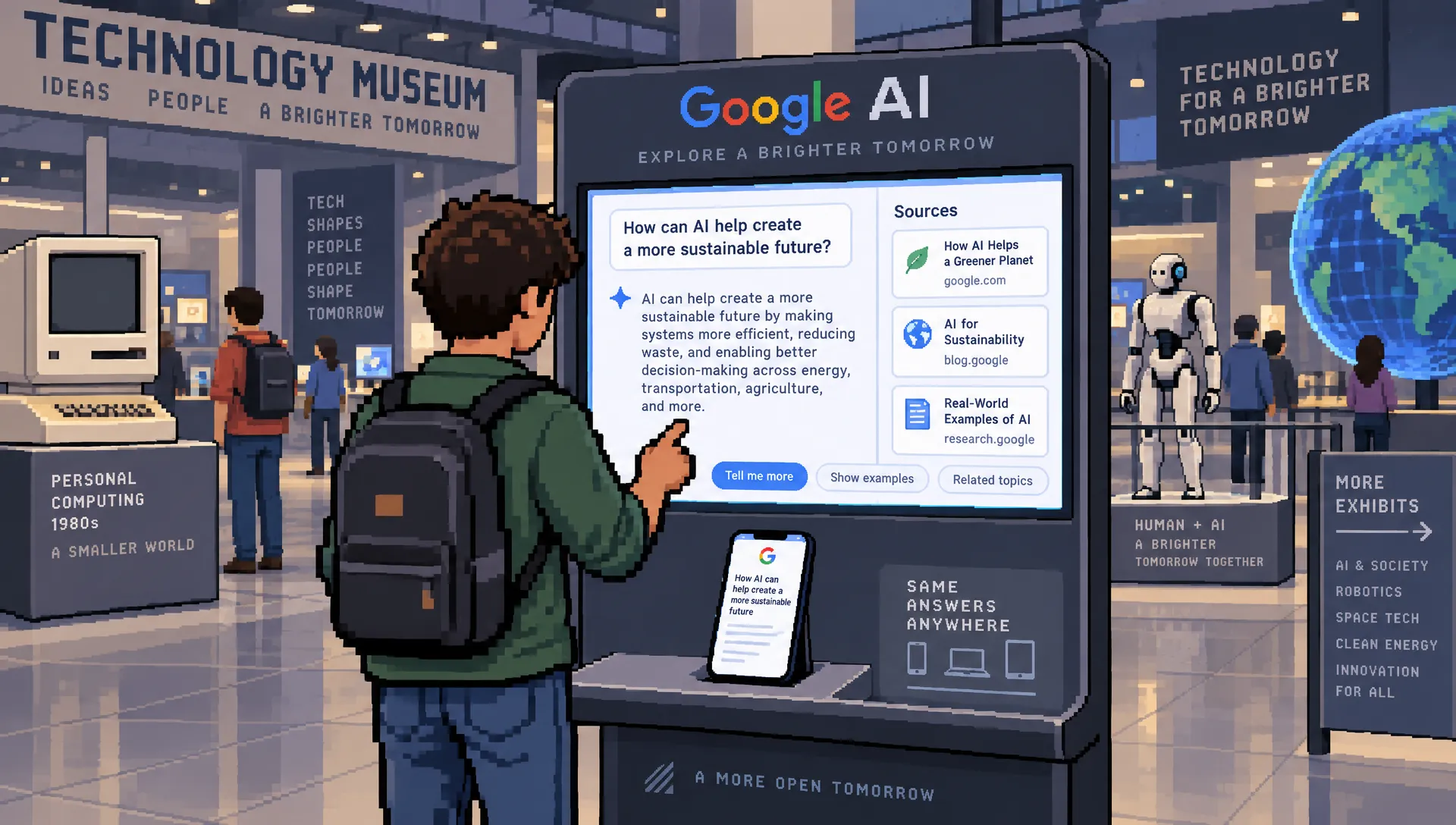
When reviewing Google search engine AI responses, distinguish the control that reveals sources from the link that actually opens a website. Selecting a citation marker may reveal a group of cards rather than immediately taking you off Google.
An inline marker makes a source association visible near a passage. A card supplies more information about a destination, potentially including a page title, domain or preview. The exact information shown can vary.
This creates two separate actions: inspecting the available sources and visiting one. A user who opens the source panel has not necessarily visited the publisher’s page.
Expanded answers can also reveal links that were not visible in the collapsed view. When documenting an interface, record whether you inspected the initial response, an expanded response or an opened source panel.
Desktop and mobile can expose links differently
A wide desktop layout can accommodate source cards beside an answer. A narrower mobile layout may place them below a passage or behind a control. Horizontal groups of cards can require additional interaction to inspect fully.
Consequently, “the source was visible” is an incomplete observation. Was its domain visible without interaction? Did the user need to expand the answer? Was the card outside the initially visible area?
For Google search engine AI visibility audits, record these distinctions rather than treating every linked page as equally prominent. A citation available after several interactions is a different exposure opportunity from a clearly labeled card beside the opening paragraph.
What a citation does and does not establish
A citation is a route to evidence, not a guarantee that the evidence supports the entire answer. A page may substantiate one feature, date or definition while offering no support for an adjacent comparison.
Consider a hypothetical AI answer comparing recruitment platforms. A link to Koann’s recruitment platform can help a reader verify how the company describes its skills-based matching features. That first-party page would not, by itself, independently establish a claim that the platform produces better hiring outcomes than its competitors.
The same distinction applies to other subjects. A manufacturer’s page can document a product specification. A research paper can report a particular experiment. Neither necessarily supports a broader recommendation added by the generated response.
Check the scope of support, not just the presence of a link. Open the page, locate the relevant passage and compare its wording with the claim. Watch for qualifications that disappear in the summary, such as a result applying only to a particular country, population or product version.
A citation in Google search engine AI should therefore be read as an invitation to inspect a source, not as independent verification of everything nearby. For a deeper checking process, use this guide to verifying sources in AI web search results.
Why your screen may not match someone else’s
The available experience can depend on country, language, device, account eligibility and the particular feature being used. Managed accounts may also face administrator restrictions. Google’s AI Overviews help page provides current product guidance, which is more useful than assuming an old screenshot describes every account.
Availability is also separate from query behavior. Having access to AI Overviews does not mean one will appear for every search. Likewise, entering AI Mode does not guarantee that each response will use the same number or arrangement of links.
Conversation history creates another difference. A follow-up such as “Which works for a small team?” depends on the earlier exchange. Its answer and sources should not be compared directly with a fresh, standalone search containing only those words.
These factors help explain why two people can report different Google search engine AI layouts without either observation being wrong. Our explanation of why AI Overviews appear for some queries but not others covers the triggering question in more detail.
How to document citations without overstating visibility
A useful citation audit records the interface state, not just a screenshot of a brand name. Start with the exact query and note whether the result appeared in standard Search or AI Mode. For a conversational response, preserve the preceding questions too.
Record the country, language, device type, date and whether the account was signed in. You do not need to collect unnecessary personal information, but you do need enough context to make comparisons meaningful.
Then distinguish the observations that are often collapsed into one metric:
- Mention: The organization or product appears in the generated text.
- Linked source: A clickable destination appears among the response’s sources.
- Initial visibility: The source is visible before expanding the answer or opening additional controls.
- Website visit: A user follows the link and reaches the publisher’s site.
These are different outcomes. A brand can be mentioned without receiving a link, while a page can appear as a source even when the answer does not name its publisher.
When measuring Google search engine AI exposure, preserve the linked URL as well as the domain. Different pages on the same website may support different claims, and a domain-level tally conceals that difference.
Repeat observations under comparable conditions before describing a pattern. A single captured response documents one result, not a permanent position.
What publishers can influence
Publishers cannot specify exactly where Google will place their source card or require a generated answer to cite them. They can make their pages eligible, accessible and easier for readers to verify.
According to Google’s documentation on AI features and websites, a supporting page must be indexed and eligible to appear in Search with a snippet. Google does not require special AI schema or a separate machine-readable AI file for these features. Eligibility does not guarantee selection.
For pages that explain a product, policy or technical issue, make the essential information easy to locate. Use descriptive headings, clear ownership and dates where timing matters. Keep qualifications beside the claims they limit. These choices help a visitor arriving through a citation determine whether the page answers their question.
Avoid interpreting ordinary rankings as a complete citation report. Google documents AI-feature traffic within Search Console’s Web search reporting, but that is not a claim-by-claim inventory of every generated answer containing your links.
An assessment of Google search engine AI performance should therefore combine controlled observations with website traffic and conversion data. Keep citation presence, click-through behavior and business outcomes separate rather than presenting them as one measure of success.
Frequently asked questions
Does every Google AI answer include citations? Do not assume every response or every claim will have a visible supporting link. Inspect the actual answer and its source controls. The availability of citations elsewhere in a response does not establish support for an uncited statement.
Are source cards ranked in order of reliability? Their display order should not be treated as a reliability score. Evaluate the destination, its evidence and its relevance to the particular claim rather than assuming the first card is the strongest source.
Does being cited mean a page ranks first in regular Google results? No. A supporting link in an AI response and a conventional ranked result are different placements. Check each separately if both matter to your reporting.
Do citation links reveal whether an answer was personalized? No. A visible source list does not explain every input used to shape the response. Review the relevant Search, account and connected-service settings rather than inferring privacy behavior from the citations alone.
Make source visibility a specific, testable goal
The useful question is not simply whether your website appears somewhere in an AI experience. It is whether the right page is linked, what the link supports and how easily a reader can reach it.
Use those distinctions to assess your current visibility, then connect the findings to a broader AI SEO strategy without confusing a citation with a click or a conversion.
Read more

How Retailers Can Prepare Product Data for the OpenAI Search Engine
AI shopping answers are only as reliable as the product records behind them. Learn how to align variants, pricing, availability and merchant feeds so shoppers get useful recommendations instead of stale or misleading details.
What Bing AI Means for Publishers Using Bing Webmaster Tools
Being indexed is not the same as being cited by an AI answer. Learn how to use Bing Webmaster Tools to diagnose discoverability, separate citations from clicks and test changes against real publishing outcomes.

How OpenAI Search Handles Paywalls and Subscriber Content
A paywalled article can appear in an AI answer without its full text being available. Learn how citations, publisher agreements and crawler controls differ, then protect subscriber content without hiding every useful preview.