
Everyone has an opinion about AI SEO.
"SEO is dead." "Just do good SEO." "Publish 10x more content with AI."
Most of it is wrong, or at best, half-right.
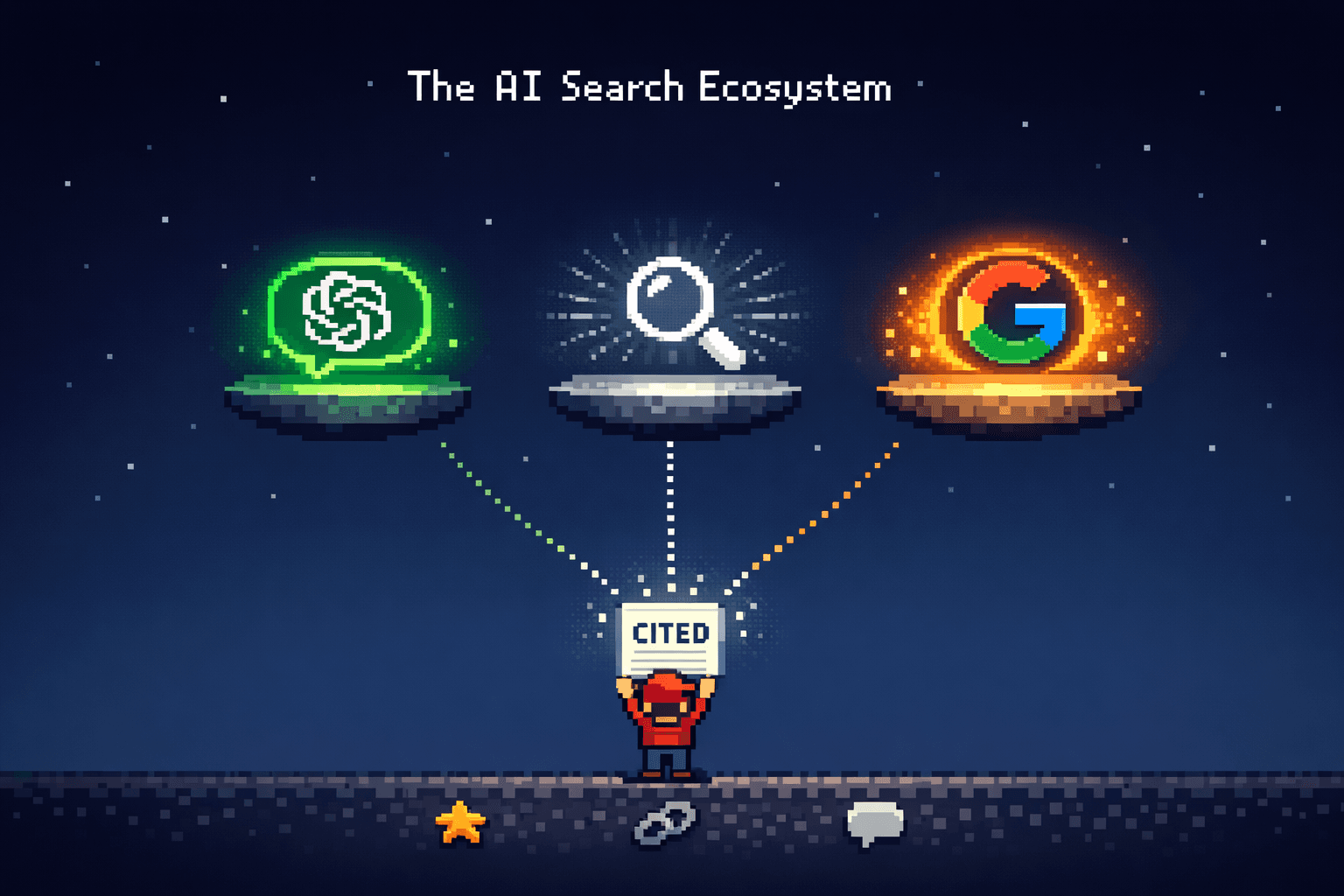
The reality is that AI search is not one thing. Google AI Overviews, ChatGPT, and Perplexity each pull from different data sources, weigh different signals, and cite content differently. µ˜ A single playbook won't cut it.
This guide breaks down what actually works for AI search visibility in 2026, backed by data, not hype.
AI Search Is Not Replacing Google. It's Adding a New Layer.
Let's start with the elephant in the room.
SEO is not dead. Not even close.
The global SEO industry is growing at over 16% annually. Google search volume continues to climb. And studies of hundreds of billions of clicks show that people who start using ChatGPT don't stop using Google. They use both.
That makes sense. If you ask an AI for "the best project management tools," you get a starting list. But you still go to Google to compare pricing, read reviews, and check what real users think.
The shift isn't from Google to AI. It's from Google alone to Google plus AI plus Reddit plus YouTube plus TikTok.
Search is fragmenting. The brands that win are the ones showing up across all of those surfaces, not just one.
Why "Just Do Good SEO" Is No Longer Enough
Traditional SEO fundamentals still matter. Metadata, structured HTML, schema markup, internal linking, and content freshness all help AI systems find and parse your pages.
But here's the gap most marketers miss: AI answer engines trust what others say about you more than what you say about yourself.
Research from AI analytics firms shows that the vast majority of brand mentions in AI search results come from third-party domains, not your own website.
That flips the traditional SEO model. On-site optimization gets you indexed. Off-site authority gets you cited.
AI visibility requires both:
- On-site clarity: technically clean, well-structured, easy-to-parse content
- Off-site credibility: mentions, citations, and expert recognition across trusted domains
If your entire SEO strategy lives on your own website, you're playing half the game.
Each AI Platform Plays by Different Rules
This is where most "AI SEO guides" fall apart. They treat AI search as a single channel.
It isn't.
Google's AI tools still lean heavily on its existing ranking system. Studies show that many AI Overviews pull from the top 10 organic results. If you rank well in Google, you have a head start for AI Overviews.
ChatGPT is a different story.
For citations (the links it uses as sources), ChatGPT frequently pulls from pages ranked outside the top 20 in Google. Your ranking position matters less.
But for brand mentions (when ChatGPT names your company in an answer), Google rankings matter more. There's a strong correlation between ranking on page one and getting mentioned by name in ChatGPT responses.
In practical terms:
- Google AI Overviews: Reward existing organic rankings and on-site optimization
- ChatGPT: Reward off-site authority and brand associations across the web
- Perplexity: Favor structured, clearly sourced content with strong citation signals
Each platform is a different game. Treat them as an ecosystem, not a single checklist.
Mentions vs. Citations: You Need Both
Here's a distinction most marketers overlook.
A mention is when your brand name appears in an AI answer. A citation is when your content is linked as a source.
They are not the same. And one does not guarantee the other.
If you had to choose in the short term, mentions matter more. When someone asks ChatGPT for "the best CRM for startups," you want your name in the answer, even without a link.
But long-term visibility compounds when you have both. Brands that are both mentioned and cited appear significantly more often in repeat AI searches.
The problem? Fewer than 1 in 10 brands manage to be both mentioned and cited consistently. Most only get one.
To earn both:
- Build mentions through PR, reviews, partnerships, community participation, and expert roundups
- Earn citations by creating structured, reference-worthy content that AI systems can easily extract from
Content Freshness Is a Ranking Factor for AI (With Caveats)
Keeping content up to date has always been good practice. For AI visibility, it's becoming essential.
Studies show that around 65% of AI bot visits go to content published within the last 12 months. When AI tools explain their source selection, recency consistently ranks as a top criterion.
But the importance of freshness varies by industry:
- Finance, HR, tax: Freshness is critical. Outdated data kills credibility fast.
- Travel, lifestyle: Broader windows. Evergreen guides still perform, but regular updates help.
- Education, technical niches: Relevance often beats recency. Well-written tutorials can attract AI bot visits years after publication.
The takeaway: prioritize freshness for fast-moving topics, but don't neglect evergreen content that remains the best answer for a given query.
Long-Form Content Is Not Dead
"AI prefers short answers" does not mean "AI prefers short content."
AI systems don't skip long articles. They skip poorly structured ones.
Content with clear headings, logical sections, and self-contained answer blocks gives AI models exactly what they need: scannable structure they can extract specific snippets from.
Long-form guides that provide comprehensive answers get cited precisely because they cover a topic thoroughly. Shallow content that's been trimmed for the sake of brevity rarely earns the kind of engagement, backlinks, and community discussion that feeds AI training data.
The key is structure, not brevity:
- Use descriptive H2s and H3s that answer sub-questions directly
- Write each section so it can stand alone as a useful answer
- Include data, examples, and original insights that make the content worth referencing
Why Publishing 10x More Content Backfires
AI makes content production cheap and fast. That tempts marketers to scale output dramatically.
The data says this doesn't work.
AI-generated content volume has exploded, but growth in actual search visibility from that content has stalled. The articles get published, but they rarely show up in Google results or AI citations.
Google's core updates have specifically targeted scaled, low-quality content. AI search platforms seem to follow the same logic: they reward original insight and authority, not volume.
Publishing 50 mediocre articles a month will always lose to publishing 5 articles that contain genuine expertise, original data, or a perspective that can't be easily replicated.
E-E-A-T Still Matters (Even Outside Google)
Experience, Expertise, Authoritativeness, and Trustworthiness aren't just Google concepts.
AI engines across the board tend to cite pages that signal credibility: clear sourcing, visible author expertise, and trusted domains. Studies show that nearly half of AI citations come from established news outlets and authoritative sources.
There are exceptions. For subjective queries like advice or step-by-step guides, AI models sometimes pull from corporate blogs and community sources like Reddit and YouTube. But even then, they consistently prefer the most credible option within that category.
E-E-A-T keeps your content trustworthy for humans and machines alike.
How to Build an AI SEO Strategy That Works
Here's the practical playbook.
1. Measure What You Can't Directly See
When someone discovers your brand through ChatGPT and visits your site three days later, it shows up as direct traffic or a branded search. Zero attribution to the AI interaction.
Watch for indirect signals:
- Rising branded search volume while organic clicks decline
- Direct traffic holding steady despite fewer Google clicks
- Prospects mentioning AI tools as their discovery channel
Dedicated AI visibility tracking tools (like Semrush's AI Visibility features) can help fill the attribution gap.
2. Own a Narrow Topic Completely
Don't try to rank for "email marketing." Own "email deliverability for SaaS companies at scale."
Pick one specific niche and dominate it with multiple content formats: beginner guides, advanced tactics, case studies, original data, and common mistakes.
When AI systems look for expertise on that topic, you want your brand to appear everywhere in the conversation.
3. Get Cited Where Your Competitors Already Are
AI models learn from clusters of authorities that appear together around a topic.
Break into that circle:
- Guest post on sites that your competitors are already cited from
- Participate in expert roundups (even without a backlink, mentions feed AI's associative learning)
- Contribute genuinely useful answers in communities like Reddit, LinkedIn, and niche forums
4. Structure Content for AI Extraction
Every section of your content should be able to stand alone as a useful answer:
- Use H2s and H3s that mirror the questions your audience asks
- Front-load the answer, then add context and depth
- Include comparison tables, step-by-step breakdowns, and clear definitions
- Add schema markup where relevant (Google has confirmed it helps with AI visibility)
5. Build Off-Site Authority Systematically
Since AI engines weight third-party signals heavily, invest in:
- PR and media mentions in trusted publications
- Customer reviews on relevant platforms
- Partnerships and co-marketing with credible brands
- Community engagement where your audience already gathers
Every mention of your brand in a credible context strengthens the association AI models learn from.
6. Keep the SEO Fundamentals Strong
AI search optimization is an expansion strategy, not a replacement.
Organic search still drives roughly 44% of website traffic. Keep optimizing site structure, fixing technical issues, and building backlinks from credible domains.
The brands that win in 2026 aren't choosing between traditional SEO and AI SEO. They're doing both.
The Bottom Line
AI search visibility is not one game. It's an ecosystem of platforms, each with different rules, different data sources, and different ways of evaluating your brand.
The brands that consistently show up are the ones that:
- Create structured, expert content worth citing
- Build authority beyond their own website
- Stay fresh and relevant in fast-moving topics
- Treat each AI platform as a distinct channel with its own playbook
Skip the hype. Follow the data. And optimize for everywhere your audience looks for answers.