
Why Google AI Overviews Appear for Some Queries but Not Others
Learn why Google AI Overviews appear for some queries, how intent and availability affect results, and how to measure visibility without guesswork.

Google AI Overviews appear selectively because Google’s systems decide whether an AI-generated summary would be a useful addition to the results for that particular search. The wording of the query matters, but so do the available information, safety considerations and the search experience available to that user.
A missing overview is not, by itself, a technical problem or an SEO failure. Two closely related searches can produce different layouts, and the same search can change over time. Understanding those differences starts with separating Google’s documented behavior from assumptions about what “triggers” an answer.
What an overview does, and what it does not
An AI Overview is a generated summary within Google Search that includes links to supporting information. It can bring together material from multiple sources rather than simply reproduce one page’s answer.
In its documentation on AI features in Search, Google explains that these experiences may use query fan-out: related searches across subtopics and sources to develop a response. This helps explain how an overview can address several parts of a question.
However, the ability to generate an answer does not mean Google will display one. Google describes overviews as appearing when its systems determine they are helpful additions to conventional results.
They are also different from AI Mode. An overview appears within a results page, while AI Mode provides a more conversational search experience with follow-up questions. The absence of an overview does not establish that the query cannot be answered through another AI search interface.
Why Google AI Overviews appear selectively
Search intent changes the value of a summary
A question that requires explanation or comparison gives a generated summary a different job from a search for a company’s login page. In the first case, combining information might help. In the second, a direct link may be enough.
The following examples illustrate that distinction. They are hypothetical tests, not verified claims about current results.
| Query pattern | Example | Why a summary might or might not help |
|---|---|---|
| Explanation | “Why does condensation form inside windows?” | An explanation can connect causes, conditions and possible remedies. |
| Comparison | “FCL vs LCL shipping for a small importer” | A synthesis can organize trade-offs across several considerations. |
| Navigation | “SHIPIT Logistics contact” | The searcher may primarily need the company’s contact page. |
| Immediate action | “Buy replacement refrigerator filter” | Product listings and retailer pages may better support the next step. |
| Live information | “Weather in Chicago now” | A dedicated weather feature may already satisfy the request. |
For example, someone researching freight forwarding and 3PL services might first compare shipping methods, then search for a specific provider. The subject stays the same, but the task changes from understanding options to finding a business.
That is why Google AI Overviews cannot be predicted reliably from topic labels alone. “Shipping,” “software” or “home improvement” can each contain informational, navigational and transactional searches.
Complexity is relevant, but it is not a switch
A detailed question can give Google more reasons to combine information. It can also make the answer harder to support.
Consider a query about choosing between two materials for an outdoor project. Adding the climate, budget and maintenance requirements could make a synthesized comparison more useful. Adding an unusual combination of constraints could instead leave too little relevant evidence for a dependable summary.
Short queries can receive generated answers, and long queries can return conventional results. There is no publicly documented word-count threshold that activates the feature.
The same caution applies to phrasing. Starting with “how,” “why” or “best” may clarify the task, but it does not unlock a guaranteed result type. Google AI Overviews are not controlled by a published list of question words or a minimum level of query complexity.
Available evidence and safety considerations matter
Generating a plausible response is different from finding sufficient support for one. Google’s systems must identify relevant information and decide whether a generated answer is appropriate for the search.
Sensitive subjects introduce additional considerations. Medical, financial and safety-related questions can have consequences that a general-interest explanation does not. That does not mean every sensitive query is excluded, or that every displayed answer is correct.
Freshness can complicate matters too. A rapidly changing event, a newly released product or conflicting public information may affect the usefulness of a summary. A live data feature, news results or direct sources may better serve the task.
Google has not published a complete trigger formula or a numerical confidence threshold that site owners can optimize against. Claims that Google AI Overviews require a particular backlink count, domain metric or schema type should therefore be treated as hypotheses unless supported by explicit documentation.
Availability and search context create additional differences
Before analyzing intent, check whether the experience is available in the relevant country, language and account context. For US searches, the feature is available, but availability does not mean it appears for every query.
Google’s AI Overviews help page is the appropriate reference for supported experiences and access requirements. Do not assume a US test applies unchanged to another market, or that experimental features available through Search Labs are identical to standard Search.
Location, language settings, device and timing can also affect what you observe. A different result does not, by itself, prove personalization. It may reflect a different local information need, a changed source set or a product experiment.
Our explanation of why AI search can give different users different answers explores those broader sources of variation. For this feature, the practical lesson is to record the search conditions rather than treating one screenshot as universal evidence.
How to investigate a missing overview
Start by identifying which of two problems you actually have: the overview is absent, or the overview appears but does not cite your website. Those are separate outcomes with different implications.
Use a small, repeatable test rather than repeatedly rewriting a query until the desired feature appears:
- Record the exact search conditions: Save the query, date, country, language, device and signed-in status, along with a screenshot.
- Classify the task: Decide whether the user wants an explanation, comparison, destination, purchase or live update.
- Test meaningful variants: Compare a broad query with a more specific version while preserving the underlying task.
- Repeat the observation: Check again on another date before concluding that the behavior is stable.
- Record citations separately: If an overview appears, note the linked pages and whether they address the query’s actual constraints.
For example, compare “LCL shipping” with “when is LCL preferable to FCL for a small shipment.” A difference would suggest that the framing affected that observation. It would not prove that longer questions always trigger summaries.
When Google AI Overviews are absent across a topic sample, investigate the mix of search intents before changing your content. When they appear but omit your site, examine relevance, eligibility and the usefulness of competing sources instead.
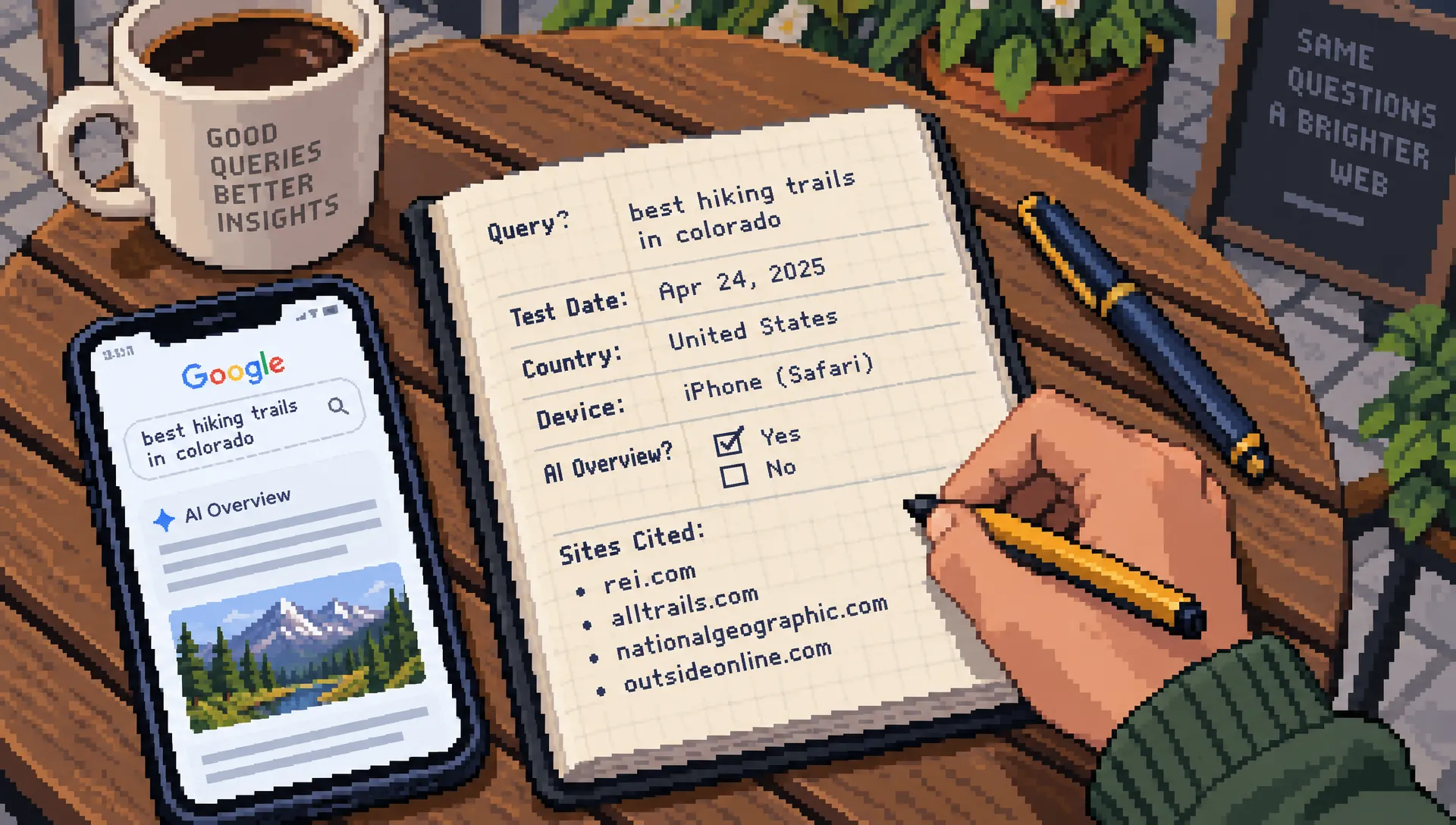
A displayed overview still needs verification
For users, the benefit is convenience: a summary can organize a topic before they open individual sources. The limitation is that fluent wording can make an incomplete or inaccurate answer seem settled.
Open the supporting links and check whether they substantiate the specific claim, not merely discuss the same subject. Pay particular attention to dates, geographic scope, units and exceptions. A source about US import requirements, for example, does not automatically support advice for every destination country.
For consequential decisions, use primary documentation or an appropriately qualified professional. Do not treat a citation as an endorsement of every sentence in the generated answer.
If Google AI Overviews contain an error, use the feedback controls provided with the feature. If your own page is cited inaccurately, check whether its wording could be misread and clarify it where appropriate. That can improve the source, but it does not give you direct control over Google’s generated response.
What selective display means for publishers
A useful measurement system separates three events: an overview appears, your page receives a citation and someone visits your website. None guarantees the next.
A page can rank organically without being cited. It can also receive a citation without generating a click, because the user’s immediate question has already been answered. Conversely, a visitor who follows a supporting link may be seeking details that the summary could not provide.
Google’s Search Central documentation describes traffic from AI features as included in Search Console’s overall Web search reporting. Do not assume that ordinary Search Console totals provide a clean, separate count of overview impressions or clicks. Check the reporting currently available in your account before promising that distinction.
Analytics has a similar limitation: a Google organic visit generally does not establish which result-page feature produced it. Measurement approaches for qualified AI referral traffic need that attribution boundary to avoid overstating results.
For Google AI Overviews, track a defined query sample alongside landing-page performance. Calculate overview presence as observations with an overview divided by all tested observations. Separately calculate citation presence within the observations where an overview appeared.
Keep the market, device and testing method consistent. These are sample-based visibility measures, not Google-wide market shares, and they should sit beside conversions and qualified visits rather than replace them.
Optimize for useful answers, not a supposed trigger formula
Google’s published guidance does not require special AI markup or a separate technical optimization system for inclusion. Standard search fundamentals still apply: Google must be able to access the page, index it and use its content appropriately.
For publishers, the most useful response is to make pages better evidence for the questions they genuinely answer. State the answer clearly, explain the conditions under which it applies and support consequential claims with identifiable sources.
Comparisons should identify real trade-offs. Instructions should include prerequisites and exceptions. Original tests should explain their methods. Pricing, regulations and other changeable details need enough context for readers to judge whether they remain applicable.
Structured data can help describe eligible content, but there is no special schema property that forces Google AI Overviews to appear or cite a page. Likewise, adding an FAQ or making every heading a question is not a guaranteed route to inclusion.
Our broader AI SEO strategy guide covers citation-oriented content planning across platforms. For this particular problem, keep the distinction clear: you can improve your page’s eligibility and usefulness, but you cannot require Google to show an overview for your preferred query.
Frequently asked questions
Why did an overview disappear for a query that showed one yesterday? Search results can change as information, ranking systems and product behavior change. Repeat the test under comparable conditions before treating the disappearance as a lasting change. It does not automatically indicate a penalty against a cited website.
Do Google AI Overviews always appear above the organic results? They are a search feature, not a guaranteed component of every results page. Their presence and presentation can vary, and other features may serve the query instead.
Can I turn them off? Google’s help guidance describes AI Overviews as a core Search feature rather than something with a universal off switch. Where available, selecting the Web filter lets you view text-based web links without features such as AI Overviews. Turning off a Search Labs experiment is not the same as disabling the standard feature.
Does no overview mean my content is unsuitable for AI search? No. An absent feature tells you about that search observation, not whether your page is eligible for citation elsewhere. Evaluate content suitability separately from whether Google chose to generate a summary.
Start with a controlled query sample
Choose a small set of searches your customers actually use. Record intent, search conditions, overview presence and citations separately. That evidence will tell you more about where to improve than a universal list of supposed trigger words.
Read more

How OpenAI Search Handles Paywalls and Subscriber Content
A paywalled article can appear in an AI answer without its full text being available. Learn how citations, publisher agreements and crawler controls differ, then protect subscriber content without hiding every useful preview.

How to Manage Your Privacy in ChatGPT Search
Turning off model training does not make web searches anonymous or erase saved information. Learn which settings control memory, location and chat retention, plus what to check before opening a result or searching with work data.

How ChatGPT and Google Handle Fresh Information
An answer can sound current while relying on old evidence. Learn how each platform finds updates, how to check time-sensitive claims and what publishers can do to make genuine changes easier to discover.