
How to Verify Sources in AI Web Search Results
Verify web search AI results with a claim-by-claim checklist for citations, original sources, dates and conflicting evidence.

Treat every web search AI answer as a set of claims to check, not a finished reference. A citation marker points toward evidence, but it does not establish that the linked page supports the sentence beside it. The source may discuss a different population, describe an older product version or simply repeat another website’s claim.
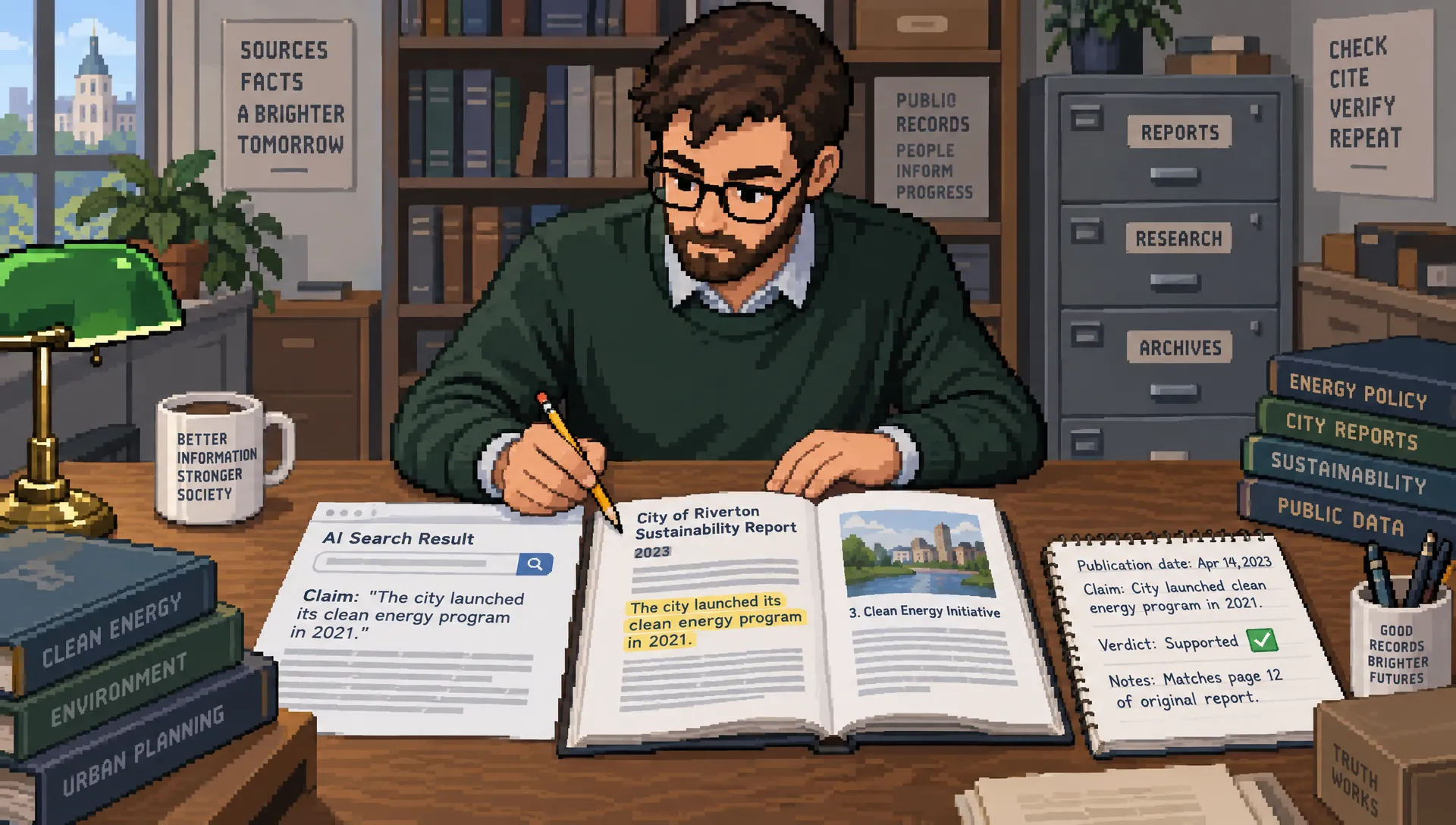
Reliable verification works at the claim level: identify the statement, find the supporting passage, evaluate the underlying evidence and decide whether the wording needs to change. This guide focuses on that inspection process, including what to do when citations are incomplete or contradictory.
Start by separating the claims
Before opening links, break the answer into statements that could be checked independently. A sentence such as “The platform launched in 2024, costs $20 monthly and is the best option for regulated businesses” contains three different claims: a launch date, a price and a recommendation.
Each requires different evidence. A dated announcement may establish the launch date. Current pricing documentation can establish the advertised price, subject to billing terms. The recommendation needs defined criteria and a comparison, not just a vendor’s marketing page.
Prioritize claims that affect a decision: numbers, quotations, legal requirements, product capabilities and statements about safety. Background explanations usually deserve less attention than a claim that could change a purchase or published recommendation.
Keep the original answer and its citations together. Save the query, response date and relevant account or location context so your notes describe the answer you actually reviewed.
Does each web search AI citation support the claim?
Open the cited page and locate the passage that supposedly supports the statement. Searching within the page for a distinctive phrase, number or named entity can speed this up. Do not stop at the headline or search snippet.
Check four things:
- Subject: Does the evidence concern the same company, product, population or event?
- Scope: Does it support the whole claim or only one part?
- Strength: Does the source say “may improve” while the answer says “will improve”?
- Conditions: Were limitations, eligibility rules or exceptions dropped from the summary?
For example, a study of one department cannot automatically establish an outcome across an entire industry. A feature available on an enterprise plan does not support a statement that every subscriber receives it.
A citation attached to a paragraph can also leave attribution unclear. Match individual statements to specific passages rather than assuming one link validates everything nearby.
Our explanation of how generative AI search engines select sources to cite distinguishes source discovery from visible attribution. Appearing in an answer is not the same as passing an evidence review.
Trace the claim back to its original evidence
A web search AI summary can accurately repeat a secondary article while still leaving the underlying claim unverified. Follow the chain backward: summary, reporting, original document or dataset.
The best source depends on the question. Official documentation is usually the right place to confirm a product’s supported functionality. Legislation and regulator guidance matter for legal requirements. Research findings call for the paper itself, including its methods and limitations.
An original source is not automatically neutral or conclusive. A company announcement establishes what the company announced, but it may not independently establish performance. Likewise, a research paper reports a study, not a universal truth.
For scholarly references, confirm that the title, authors, publication and DOI match. Crossref’s metadata search can help identify a publication, but finding a matching record does not validate the study’s conclusions or the AI’s interpretation.
If a news report mentions a survey, look for the questionnaire, sample, fieldwork dates and sponsor. Without those details, you may be able to attribute the reported finding, but you cannot confidently generalize it.
Check dates, versions and jurisdiction
Freshness is not just a publication date. When reviewing web search AI results, distinguish when a page was published, when it was updated and when the underlying event or measurement occurred.
An article updated this month may still cite a survey conducted years ago. A current documentation page might describe a feature introduced after the period you are researching. Both can be legitimate sources used in the wrong context.
For changing facts, look for the effective date and applicable version. Pricing can depend on currency, billing frequency and region. Regulations can differ by jurisdiction and commencement date. Product capabilities may vary by plan or deployment environment.
Ask a precise question: “Was this true for this location, version and time period?” That is more useful than asking whether the page looks recent.
When historical accuracy matters, an archived page can help establish what a website displayed at a particular time. It cannot, by itself, prove that the displayed claim was correct. Record your access date too, especially when the page can change without preserving earlier wording.
Check independence, not just the number of links
Multiple citations in web search AI results can create an impression of agreement even when every page traces back to one press release. Count independent evidence sources, not websites repeating the same statement.
Look for identical wording, matching statistics and shared links to an original announcement. Syndicated reporting and articles summarizing the same study may add context, but they do not represent separate confirmations of the underlying finding.
Also assess the publisher’s relationship to the claim. A vendor has direct knowledge of its product and a commercial interest in selling it. An affiliate publisher may earn commissions. Those incentives do not make the information false, but they affect how you should evaluate recommendations and comparative claims.
Ask whether the author explains their methods, identifies limitations and provides evidence you can inspect. A recognizable publisher name is useful context, not a substitute for those checks.
For technical or disputed claims, seek evidence that could challenge the answer. Searching only for the exact wording of its conclusion can lead you through a chain of repetitions without exposing a meaningful disagreement.
Worked example: checking an AI claim about crypto mining
Consider this hypothetical sentence in a web search AI answer: “AI reduces electricity costs and makes crypto mining sustainable.” It combines an operational claim with a much broader environmental conclusion.
An article about AI and automation in crypto mining provides a concrete example of industry commentary covering energy optimization, predictive maintenance and operational risks. Its commercial context and 2025 framing are relevant when deciding how to use it as evidence.
To check the electricity-cost claim, look for measured results with a clear baseline. What hardware was used? Did electricity prices change? Were cooling conditions, workload and measurement periods comparable? A description of a possible benefit is not evidence that every operator achieves it.
Then evaluate the environmental claim separately. Lower energy use per unit of computation does not automatically establish lower total emissions. Electricity mix, total consumption and the boundaries of the assessment still matter.
If the evidence only explains potential applications, the defensible wording is narrower: “AI-based controls may help optimize energy use, depending on implementation and operating conditions.” Do not present a specific savings figure or a general sustainability conclusion without supporting measurements.
Assign a verdict before reusing the claim
Record what your review established instead of marking every linked statement “verified.” A source can support part of a sentence while leaving its central conclusion unresolved.
A compact evidence ledger helps keep these distinctions visible:
| Verdict | What you found | What to do next |
|---|---|---|
| Supported within scope | The source directly supports the statement under matching conditions | Retain the claim and its relevant limitations |
| Partially supported | Evidence covers only part of the statement or a narrower context | Split or qualify the wording |
| Unsupported by the citation | The linked source does not establish the claim | Find suitable evidence or remove it |
| Contradicted | Relevant evidence conflicts with the statement | Correct the claim and investigate the discrepancy |
| Unresolved | Essential evidence is inaccessible, missing or inconclusive | State the uncertainty or avoid relying on it |
For each entry, save the exact claim, source URL, supporting passage, date context and reason for the verdict. These notes make later review easier and reduce the chance that a qualified finding becomes an absolute claim during editing.
The goal is not to certify an entire web search AI answer with one label. It is to preserve a traceable relationship between each consequential statement and the evidence that supports it.
Handle inaccessible sources and conflicting evidence
If a citation leads to a broken page, paywall or unavailable document, do not infer its contents from the AI’s summary. Search for the exact title, author or document identifier. An official repository or legitimate author manuscript may provide access.
An abstract can help establish a paper’s topic and reported findings, but it may omit methods, subgroup results and limitations. Restrict your conclusion to what you can inspect, or mark the claim unresolved.
When sources disagree, compare definitions before deciding which one is right. They may measure different populations, use different denominators or describe different periods. A percentage increase and a percentage-point increase, for example, are not interchangeable.
If a genuine conflict remains, describe it rather than averaging incompatible figures. For high-stakes medical, legal or financial decisions, unresolved evidence should prompt review by an appropriately qualified professional.
NIST’s Generative AI Profile identifies confabulation, including confidently presented false content, as a generative AI risk. Fluent wording is therefore not a reason to lower your evidence standard.
Frequently asked questions
Can I ask the AI to verify its own citations? Yes, as an assistance step. Ask it to map each claim to an exact source passage and identify unsupported statements. However, another web search AI response is not independent evidence. Open the sources yourself before relying on consequential claims.
Does a real citation mean the answer is accurate? No. The page may exist but concern a different subject, support only a narrower statement or contain a claim without adequate evidence. Citation existence, citation relevance and factual accuracy are separate checks.
How many sources do I need? There is no universal minimum. One authoritative document can establish a narrow fact such as an official effective date. A contested causal claim may require several independent sources and closer examination of their methods.
What if the answer is correct but its citation is wrong? Replace the citation with evidence that actually supports the statement. Do not preserve an irrelevant link simply because you found confirmation elsewhere. Your reader should be able to follow the reference and understand the basis for the claim.
Publish only what the evidence supports
Before reusing web search AI findings, resolve unsupported claims, preserve important qualifications and link to the evidence you actually inspected. A shorter answer with clear boundaries is more useful than a confident summary whose references do not hold up.
If the findings are going into an article, use an SEO checklist for reviewing AI content before publishing alongside your evidence ledger. Keep verification notes with the draft so future updates can revisit the facts, not just refresh the wording.
Read more

How OpenAI Search Handles Paywalls and Subscriber Content
A paywalled article can appear in an AI answer without its full text being available. Learn how citations, publisher agreements and crawler controls differ, then protect subscriber content without hiding every useful preview.

How to Manage Your Privacy in ChatGPT Search
Turning off model training does not make web searches anonymous or erase saved information. Learn which settings control memory, location and chat retention, plus what to check before opening a result or searching with work data.
How ChatGPT and Google Handle Fresh Information
An answer can sound current while relying on old evidence. Learn how each platform finds updates, how to check time-sensitive claims and what publishers can do to make genuine changes easier to discover.