
Which SEO Optimization Tasks Should You Automate With AI?
Explore seo optimization ai workflows that save time. Learn what to automate, what to review and how to measure search performance.
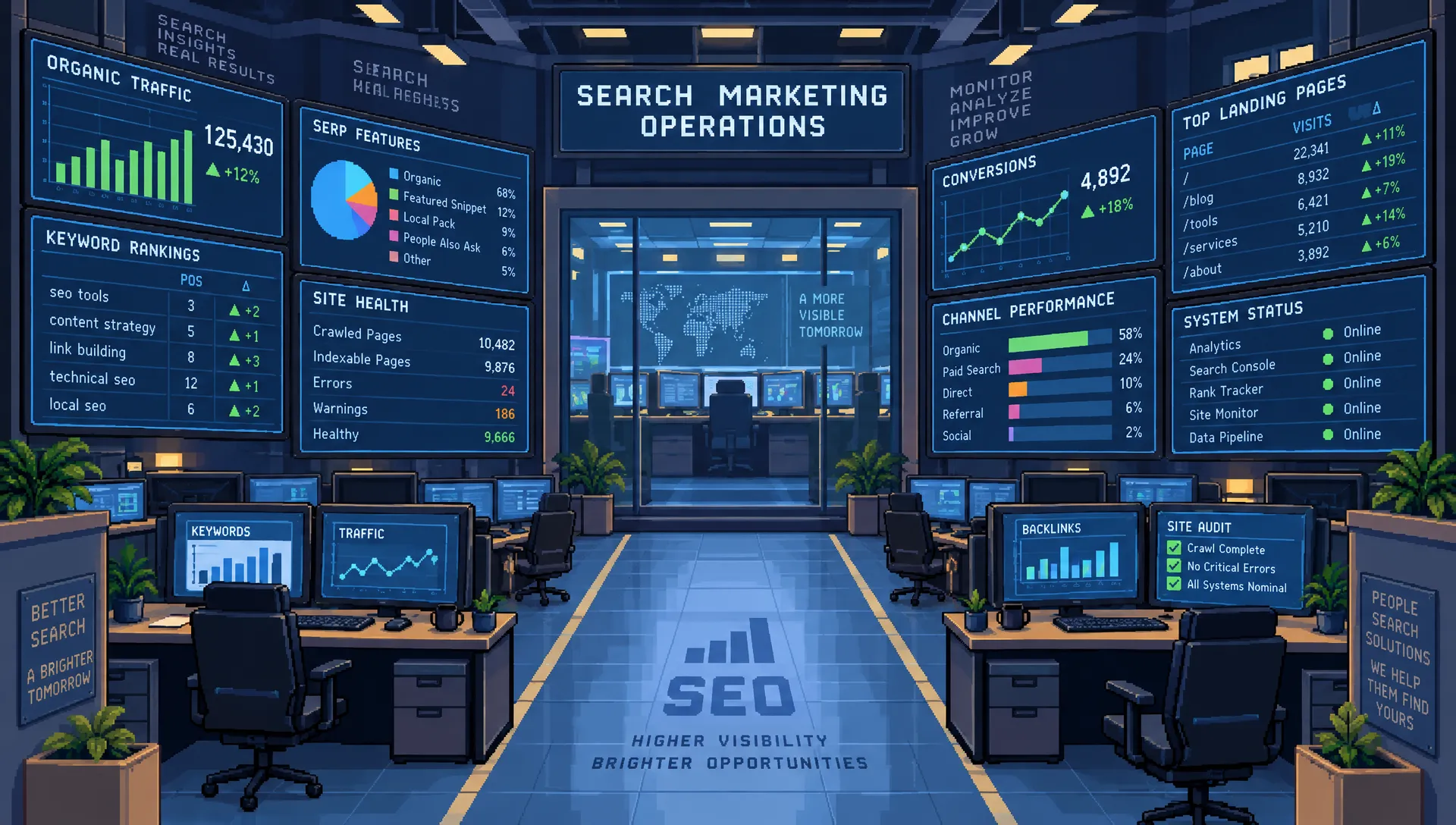
Searching for “seo optimization ai” often mixes up two goals: using AI to perform SEO work and improving your visibility in AI-generated answers. This guide focuses on the first. The decision is not whether AI can complete a task, but whether it can complete it reliably enough to reduce your total workload.
Automate repetitive analysis and monitoring first. Use AI to draft recommendations second. Keep consequential publishing and technical decisions under human control. Reporting, keyword grouping and issue classification are usually better starting points than automatic article production or sitewide changes.
Good automation also needs boundaries. A system that produces 100 recommendations but requires hours of verification may create more work than it removes. Likewise, a workflow that saves editing time but introduces inaccurate claims is not an operational improvement.
The framework below separates tasks by risk, explains the controls each needs and shows how to test whether automation delivers useful results.
How to prioritize “seo optimization ai” tasks
Assess each task against four criteria: repetition, verifiability, consequences and reversibility. Strong candidates happen frequently, use consistent inputs, have checkable outputs and can be undone without major damage.
| Task | Appropriate automation level | Essential control |
|---|---|---|
| Reporting and anomaly detection | Automate collection and initial flags | Validate data freshness and comparisons |
| Keyword grouping | Generate proposed clusters | Review intent and page mapping |
| Crawl issue classification | Automate triage | Confirm issues before implementation |
| AI-search citation monitoring | Automate permitted collection | Inspect sources and sampling conditions |
| Content briefs and metadata | Generate drafts | Require editorial approval |
| Redirects, canonical tags and indexing rules | Suggest changes only | Require technical review and testing |
Also distinguish AI from ordinary automation. Scheduling an export or checking whether a URL returns a 404 does not require a language model. Use deterministic rules for exact checks and AI for interpreting language, grouping patterns or summarizing evidence.
For smaller teams, a focused backlog of SEO quick wins for small business owners can help establish priorities before automation becomes a project of its own. Automating a low-value task does not make it valuable.
SEO tasks you can automate first
Reporting and anomaly detection
Connect reliable inputs before asking AI to explain performance. Google Search Console, GA4 and crawl exports can supply the underlying records. A scheduled process can collect those records, compare equivalent periods and flag unusual changes.
AI can then summarize the exceptions: which page groups lost clicks, where impressions rose without corresponding traffic or which landing pages need investigation. Require every observation to identify its source, date range and affected pages.
For SEO optimization, AI works best here as an analyst’s assistant, not a causal authority. A traffic decline does not prove that a recent edit caused it. Seasonality, demand changes, tracking problems and search-result changes may also contribute.
Separate detection from diagnosis. Let the workflow open a review ticket when a threshold is crossed, but require a person to confirm the explanation. Include data freshness checks so an incomplete reporting period does not trigger a false alarm.
Keyword clustering and question research
AI can propose groups from a supplied keyword list, label likely intent and identify questions that deserve closer examination. This is useful when hundreds of variations make manual sorting slow.
Provide evidence alongside the terms: existing landing pages, available search-result observations and business priorities. Ask the model to distinguish informational research from comparison, purchase and support intent. Require an “uncertain” category instead of forcing every query into a confident cluster.
For example, “CRM pricing” and “how to build a CRM budget” share vocabulary but may need different pages. Conversely, differently worded questions may belong on one useful page.
AI-assisted SEO optimization should reduce sorting time without turning each keyword into a publishing assignment. Our guide to grouping SEO keywords by search intent explains the clustering process in more detail. The final decision still needs page-level judgment: expand an existing resource, create something distinct or publish nothing.
Technical crawl triage
Use a crawler to detect technical conditions, then use AI to organize the findings. Suitable inputs include broken internal links, redirect chains, duplicate titles and pages with conflicting indexing signals.
The valuable output is not a longer issue list. It is a prioritized explanation that identifies affected templates, likely scope and what should be checked next. A recurring problem across product pages may deserve a template fix rather than hundreds of individual tickets.
Keep severity rules explicit. A broken link on an important navigation path should not receive the same priority as an obsolete URL with no meaningful internal links or business role.
Technical SEO optimization with AI should stop short of silently changing production settings. The model can suggest a redirect mapping or explain a canonical conflict, but an engineer or SEO owner should validate the intended destination, implementation and rollback method. Never let a generated explanation substitute for checking the actual response, rendered page or configuration.
AI-search visibility monitoring
Monitoring citations and brand mentions is another candidate, provided collection methods comply with platform terms and access controls. Use a documented panel of questions based on real customer needs rather than a collection of prompts designed to make your brand appear.
Record the platform, question, date, relevant settings, cited URLs and whether the answer mentioned the brand. Repeat observations because generated answers can vary. Keep brand mentions separate from clickable citations and factual accuracy.
For Google’s AI features, Google’s documentation explains that established SEO practices remain relevant; there is no special optimization required for inclusion. Do not buy an automation workflow on the assumption that a particular formatting trick guarantees citations.
This part of AI-powered SEO optimization measures visibility, not revenue. A cited page may receive no visit, and an uncited brand mention may still influence a buyer. Treat the sample as directional evidence with defined boundaries, not a complete record of what every customer sees.
Tasks AI should draft, not finish
Content briefs and update recommendations
AI can compare an existing page with an approved brief, identify unanswered questions and propose an update outline. Supply the page, audience, intended action and verified source material. Ask it to identify evidence gaps rather than invent missing facts.
A useful recommendation explains what should change and why. “Add more detail” is weak. “Explain cancellation terms because this comparison page does not answer a purchase-stage question” gives an editor something specific to assess.
Keep business facts outside the model’s discretion. Product capabilities, prices, contractual terms and customer results should come from approved records. If those records are unavailable, the output should flag the omission.
In content-focused SEO optimization, AI should prepare evidence-backed options, not decide that every page needs expansion. Sometimes the right action is to remove repetition, merge overlapping resources or leave a successful page alone. Apply a consistent review checklist for AI-assisted content before publication.
Titles, descriptions and internal-link suggestions
These tasks are easy to batch, but they still require context. Generate title and description candidates from the actual page content, then check that they accurately represent the offer and intent.
Reject invented benefits, unsupported superlatives and language that makes several pages indistinguishable. Set length preferences as editorial guidelines, not guarantees of how search engines will display the result. Search engines may generate different titles or snippets.
For internal links, require the proposed source page, destination page, anchor text and a short explanation of reader value. Validate that the destination exists and addresses what the anchor promises.
AI-assisted SEO optimization becomes risky when a plausible suggestion is mistaken for a verified instruction. A link between vaguely related pages is not automatically helpful, and a prominent destination should not receive links from every article. Review a small batch before expanding the workflow, especially when navigation or commercial pages are involved.
Structured data and code recommendations
AI can draft structured data from verified page information or explain a proposed template change. It should not invent reviews, ratings, authors, product availability or business details to fill missing properties.
Validate generated markup against the relevant requirements and check that it matches visible content. Valid syntax alone does not establish eligibility for a search feature or guarantee its appearance.
Apply the same restraint to code. Test changes in staging, inspect affected templates and identify an owner before deployment. A small-looking change to rendering, canonical tags or robots directives can affect many URLs.
Use deterministic validation wherever possible. AI’s role is to propose and explain; validators, tests and human review establish whether a change is safe to ship. Keep a versioned copy of the previous implementation so reversal does not depend on reconstructing it later.
Decisions that should remain human-owned
Keep strategy, factual accountability and high-impact deployment with named people. These decisions involve trade-offs that the model cannot settle from a keyword export or crawl report.
Examples include choosing which audiences to serve, deciding whether two pages should merge, approving claims about regulated subjects and changing a migration plan. Outreach also needs oversight: automated personalization can misrepresent relationships or send inaccurate pitches at scale.
Publication volume deserves the same restraint. Google’s scaled content abuse policy concerns producing large amounts of content primarily to manipulate rankings rather than help users, regardless of how that content is created.
Responsible SEO optimization with AI therefore needs an accountable owner for every workflow. Someone must be able to explain why a recommendation was accepted, what evidence supported it and what happens if it fails. “The model suggested it” is not an approval standard, particularly when customers, revenue or search accessibility are affected.
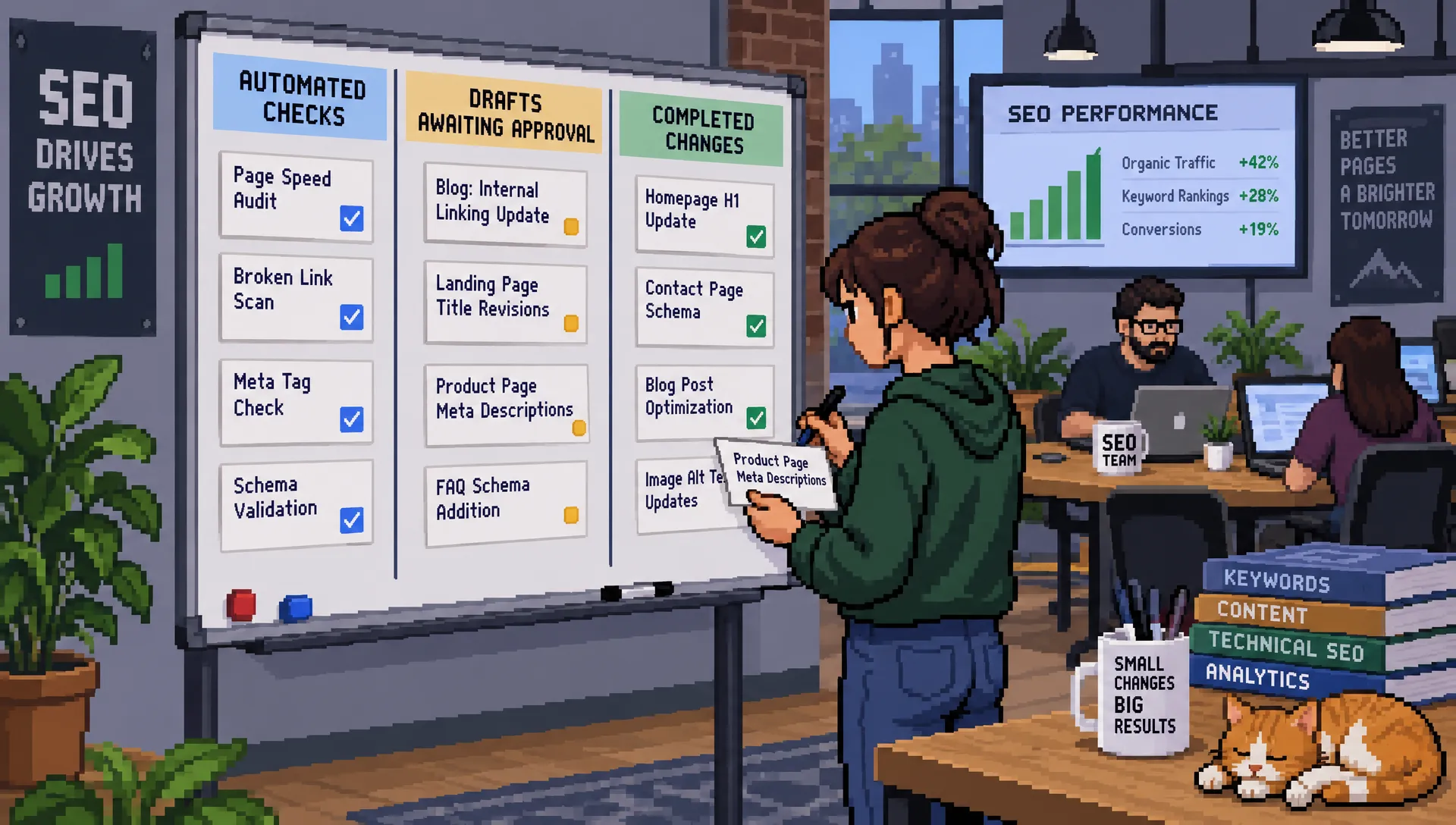
Test tools on your work, not their feature lists
Evaluate competing tools with the same representative tasks and inputs. A polished demonstration is not evidence that a product can handle your site’s terminology, templates or ambiguous cases.
Build a small benchmark from completed work. For example, select 30 cases across keyword grouping, metadata drafting and crawl triage. Include straightforward examples, unclear cases and known traps. Establish acceptable outputs with your SEO or editorial owner before running the test, and reserve some cases for a final check after setup.
Record manual completion time as the baseline. Then measure setup time, generation time, review time and corrections for each tool. Score factual accuracy, intent alignment, unsupported assertions, instruction compliance and operational fit. Mark critical failures separately; an average quality score can hide a single dangerous recommendation.
For any product marketed around “seo optimization ai,” inspect the output rather than trusting its self-evaluation. Can reviewers trace a claim to an input? Does the system acknowledge missing information? Does it preserve uncertainty, or manufacture confidence?
Also test exports, permissions and repeatability. A tool that performs well once but cannot preserve a review trail may be unsuitable for recurring work.
Choose the option with the best accepted output per unit of total effort, not the longest feature list. Avoid judging the trial by ranking changes alone. A short operational benchmark can establish quality and efficiency; it cannot establish a causal search-performance improvement.
Build privacy and failure controls into the workflow
Before connecting a model to SEO data, classify what it will receive. Public page copy is different from customer records, unpublished pricing, authentication details or commercially sensitive analytics.
Review the provider’s applicable terms for retention, model training, deletion, subprocessors and access controls. Do not assume that every plan or integration has the same protections. Remove unnecessary identifiers and use the least access required. Drafting metadata does not require unrestricted publishing permissions.
Treat crawled pages and uploaded documents as untrusted source material. They can contain instructions intended to redirect an AI system. Configure the workflow to analyze that material as data, not follow instructions embedded within it. Restrict available tools and destinations accordingly.
Safe AI-assisted SEO optimization also needs input checks and stopping conditions. Pause processing when source files are empty, required fields disappear, outputs contain nonexistent URLs or the volume of proposed changes exceeds an approved limit.
Keep inputs, prompt versions, outputs, approvals and deployed changes in an access-controlled log with an appropriate retention policy. This makes failures diagnosable without retaining sensitive information indefinitely. Test the stop and rollback procedures before you need them during a live incident.
Measure efficiency, search outcomes and business value separately
Start with operational measures: time per accepted task, correction rate, rejected outputs and critical errors. These show whether automation is actually helping the team.
A useful calculation is:
Net time saved = previous task time minus setup, processing, review, correction and maintenance time.
Compare equivalent workloads and spread setup costs across a realistic operating period. Include tool charges and engineering support when calculating financial value. A workflow that saves writer time but doubles editorial review may have no net benefit.
Next, monitor search outcomes appropriate to the task. Technical fixes may be evaluated through crawl results, indexing observations and affected page performance. Content changes may warrant query-level impressions, clicks and qualified landing-page visits. Where practical, compare changed pages with similar unchanged pages, while recording releases, campaigns and seasonal influences.
Business outcomes belong in a separate layer: qualified inquiries, signups, purchases or another meaningful conversion. Use consistent tracking definitions and remember that attribution is incomplete.
For AI-search visibility, keep citation observations alongside identifiable referral traffic and downstream actions. Our guide to assessing whether AI search sends qualified traffic explains that distinction.
The goal of SEO optimization with AI is not more generated output. It is useful work delivered with lower total effort, controlled risk and evidence of business relevance. Report those dimensions separately rather than combining them into a single opaque success score.
A practical first-month rollout
Week 1: Pick one bounded workflow. Choose reporting summaries, keyword triage or another recurring task with stable inputs. Record the current process, baseline effort, acceptance rules and accountable owner. Exclude production changes from the initial scope.
Week 2: Run in parallel. Let the automation produce outputs without replacing the existing process. Compare results, investigate disagreements and revise instructions or validation rules. Include difficult cases rather than testing only clean examples.
Week 3: Introduce controlled use. Let reviewers use accepted outputs, but retain approval gates and a simple off switch. Track actual correction time, not just how quickly the system generates a response.
Week 4: Decide whether to expand. Increase scope only if quality and net savings hold across representative work. Otherwise, narrow the task or stop. For SEO optimization, AI should earn broader responsibility through observed performance, not receive it because the integration makes deployment easy.
Frequently asked questions
Can AI automate all SEO work? It can automate parts of many workflows, but strategy, verification and high-impact changes still need accountable human judgment. End-to-end autonomy is a poor default when errors can spread across a website.
Which task is the safest starting point? Reporting summaries based on validated data are often a sensible pilot because they can remain read-only. Keyword grouping is another option when a reviewer checks intent before the results influence page creation.
Should AI publish articles automatically? Most teams should begin with drafts and mandatory approval. Publishing requires verified claims, original value and alignment with the audience. Producing text successfully does not establish that the page deserves to exist.
Does using AI for SEO improve visibility in ChatGPT or Google AI answers? Not automatically. Workflow automation and inclusion in generated answers are different outcomes. Measure citations separately, maintain accessible and useful content and avoid treating any tool or markup as a guarantee.
Choose one workflow before adding more tools
Start with a recurring task you can verify and reverse. Document the baseline, require review and measure net savings. Explore Search Optimization for further guidance as you build a more reliable AI-assisted SEO process.
Read more

How OpenAI Search Handles Paywalls and Subscriber Content
A paywalled article can appear in an AI answer without its full text being available. Learn how citations, publisher agreements and crawler controls differ, then protect subscriber content without hiding every useful preview.

How to Manage Your Privacy in ChatGPT Search
Turning off model training does not make web searches anonymous or erase saved information. Learn which settings control memory, location and chat retention, plus what to check before opening a result or searching with work data.

How ChatGPT and Google Handle Fresh Information
An answer can sound current while relying on old evidence. Learn how each platform finds updates, how to check time-sensitive claims and what publishers can do to make genuine changes easier to discover.