
An SEO Checklist for Reviewing AI Content Before Publishing
Use this SEO AI content checklist to verify claims, match search intent, check technical SEO and approve drafts with clear publishing standards.
An SEO AI content review should answer one practical question: would this page deserve publication if a knowledgeable reader checked every claim? Fluent writing is not enough. A draft can sound convincing while solving the wrong problem, inventing a product detail or duplicating an existing page.
Use this checklist as a release process, not a request to make an AI draft sound “more human.” It separates editorial judgment from factual verification and technical checks, with clear reasons to publish, revise or hold a page.
Apply every check to the version going into your CMS. Reviewing a document is useful, but the published page can introduce different headings, broken links, missing images or accidental indexing restrictions.
1. Confirm search intent and page ownership
Write down the reader’s task in one sentence before editing. “Help a marketing manager evaluate whether an AI-written article is ready to publish” is actionable. “Cover AI and SEO” is too broad to guide a review.
Then compare the draft’s format with the task. A checklist should provide observable checks and decisions. A comparison needs meaningful differences and selection criteria. A troubleshooting guide should connect symptoms to likely causes and fixes.
Your SEO AI content review should also establish whether this URL needs to exist. Search your own site for pages answering the same primary question. Similar vocabulary is not automatically a problem, but two pages serving the same audience, task and outcome may compete unnecessarily.
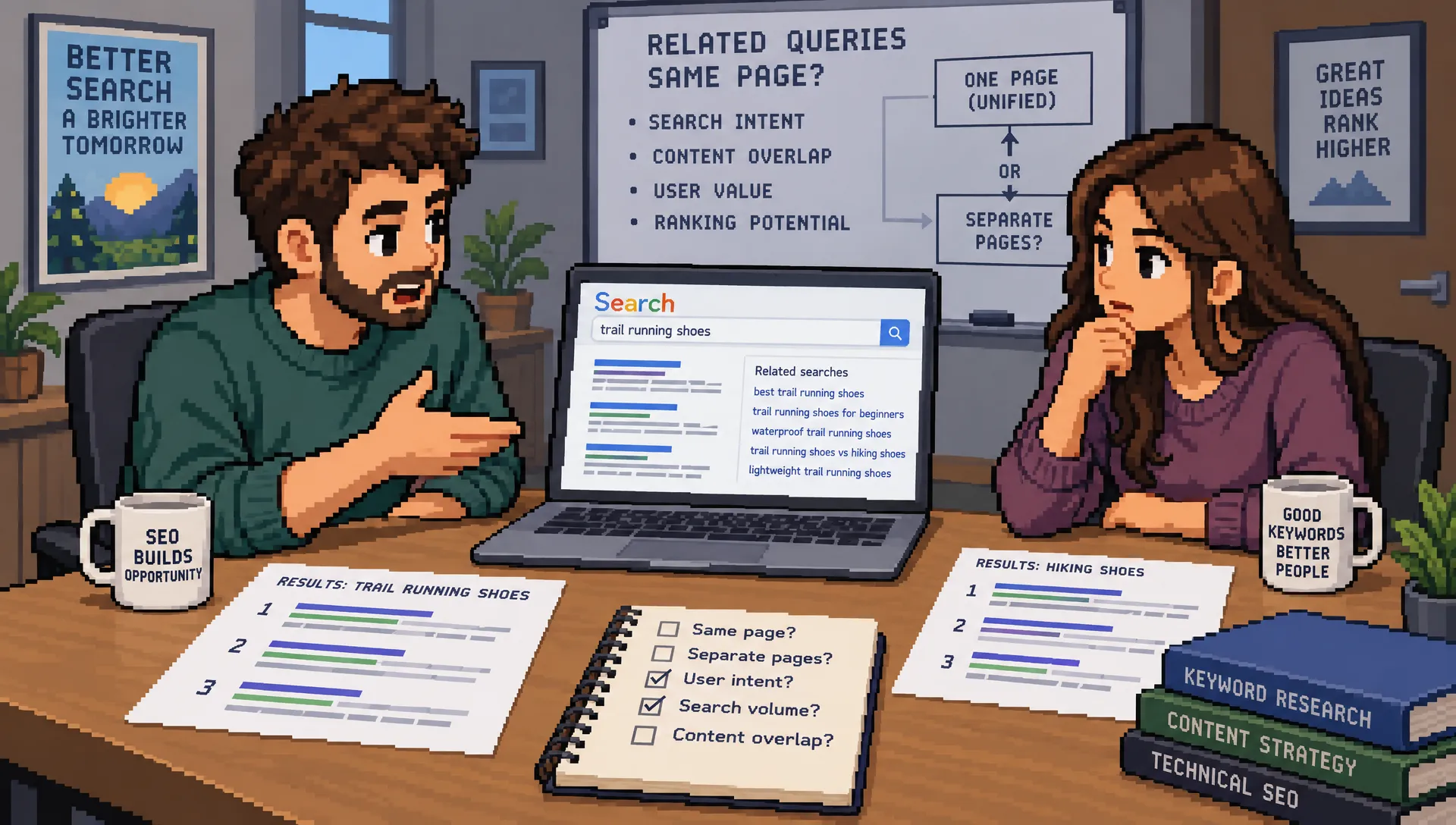
When several queries appear related, use search-intent keyword grouping to clarify which belong on one page before commissioning another article.
Pass when: The draft serves a specific task, uses an appropriate format and has a distinct role within the site.
Hold when: The core answer belongs on an existing page or the draft promises something its content does not deliver. Resolve the page’s purpose before spending time on sentence-level edits.
2. Verify every consequential claim
Read the draft once purely as a fact-checker. Highlight numbers, dates, quotations, product capabilities, pricing, legal assertions and statements about how search systems work. Also flag confident generalizations such as “always improves rankings” or “Google prefers this format.”
Open the underlying source. An AI-generated citation, search snippet or familiar-looking domain is not verification. Confirm that the page exists, supports the specific claim and applies to the same population, product version or time period.
In an SEO AI content workflow, one unsupported promise about your product can matter more than dozens of minor style issues. Verify those claims against approved documentation or a responsible product owner, not another generated answer.
For statistics, inspect the denominator and methodology. A study of selected websites does not automatically describe every business. A correlation between a page feature and rankings does not establish that adding the feature causes improvement.
Treat health, financial, legal and safety-related advice as higher risk. Route consequential recommendations to a qualified reviewer rather than assuming a general editor can validate them.
Pass when: Material claims are supported, appropriately qualified and current enough for the decision they inform.
Hold when: A central recommendation depends on evidence nobody can inspect, or a fabricated quotation or product claim remains unresolved.
Keep a claim ledger reviewers can inspect
For consequential claims, record the wording, supporting source, relevant passage, verification date and reviewer. This creates an audit trail that survives handoffs and makes later updates easier.
The examples below illustrate review actions, not findings about a particular product.
| Draft claim | Evidence needed | Review action |
|---|---|---|
| “The platform integrates with this CMS” | Current integration documentation | Verify availability and any limitations |
| “This approach increased conversions” | Original measurement and attribution method | Include context or remove the result |
| “Google requires this markup” | Applicable Google documentation | Correct requirements versus recommendations |
An SEO AI content review becomes easier to repeat when the ledger distinguishes “verified,” “needs qualification” and “unverified.” A bibliography alone does not show which source supports which sentence.
An assistant can help identify checkable claims, but give it a constrained task: extract the exact wording, explain what needs verification and leave the evidence field blank. Do not ask it to fill gaps with plausible references.
Keep the ledger with the editorial record. Public citations should support the reader’s understanding; the internal record should support accountability.
3. Check for value only your team can add
Ask what the page contributes beyond a tidy summary of widely available material. The answer does not have to be original research. It might be a worked example, an observed limitation, a decision rule, a reproducible test or a template readers can use immediately.
For example, an article about content approval becomes more useful when it shows what blocks publication and who resolves the problem. Another paragraph explaining that “quality matters” contributes little.
The strongest SEO AI content drafts connect general guidance to verifiable experience. If the article says “we tested,” document what was tested, by whom and under what conditions. If no test occurred, present the passage as a hypothetical example instead.
Google’s guidance on helpful, reliable, people-first content provides useful review questions about originality, sourcing and demonstrable knowledge. Use those questions to challenge the draft, not to manufacture signals of expertise.
Add a real byline where appropriate and describe credentials accurately. Do not invent first-person experience or imply that a reviewer performed work they only read about.
Pass when: The page offers a practical contribution readers can identify and trust.
Revise when: Removing the brand name would leave a generic summary that could appear on almost any competing site.
4. Review topical coverage without chasing a score
Compare the draft with the reader’s task, relevant search results and authoritative documentation. Look for missing prerequisites, important exceptions and questions a reader must answer before acting. Do not copy competitors’ headings simply because several pages share them.
Check the primary query in the title, opening and relevant headings, but judge phrasing in context. A keyword recommendation is not a reason to make a sentence awkward or repeat an idea the reader already understands.
For SEO AI content, coverage means answering the right questions, not including every associated term. A publishing checklist needs verification and release criteria; it does not need a long history of machine learning.
Choose tools according to the bottleneck. A general assistant can compare a supplied draft against a brief. A specialist platform may be useful when the team needs inventory analysis, topic planning or repeatable content-gap reviews. This MarketMuse platform profile provides a starting point for evaluating that type of specialist tool.
Confirm current capabilities and test the tool against your own content before committing. No optimization score proves factual accuracy, originality or business relevance.
Pass when: Essential questions are answered at the right depth and terminology feels natural.
Revise when: Sections exist mainly to satisfy a term list, duplicate another passage or inflate article length.
5. Edit for people and extractable answers
Read the introduction and the first sentence beneath each heading. Together, they should reveal what the article helps readers do. Replace extended scene-setting with the answer, then add evidence, conditions and examples.
Use headings that describe the decision or task. “Validate product claims against documentation” is more useful than “Unlocking trust.” Keep paragraphs focused, explain unfamiliar terms and remove conclusions that repeat the introduction without adding a next step.
Make key passages understandable when read independently. Define the subject rather than relying on “this approach” after a long gap. Place units, dates and limitations beside the claim they qualify. These habits help readers who scan and reduce ambiguity when a passage is quoted.
A careful SEO AI content edit should preserve nuance rather than turn every answer into an absolute. “This may improve eligibility” and “this guarantees visibility” make very different promises.
Read a sample aloud to catch repetitive sentence structures, empty transitions and unnatural keyword placement. An AI-detector score cannot establish whether the page is accurate or useful; review the writing and evidence directly.
Pass when: A reader can find the answer quickly and understand the conditions attached to it.
Revise when: The prose sounds polished but requires several paragraphs of interpretation before the reader knows what to do.
6. Audit links, media and trust signals
Click every link in the rendered preview. Confirm that the destination supports the nearby statement, loads correctly and is appropriate for readers. A working link to an unrelated page is still a failed citation.
Use internal links where they help someone complete the next step. Avoid sending every occurrence of a phrase to the same destination or adding links purely to meet a quota. Anchor text should set an accurate expectation about the destination.
Check images for relevance, usage rights and accuracy. Screenshots should represent the product version discussed. Charts need clear units, labels and source context. If an illustration is synthetic, it must not masquerade as a real customer result or product screenshot.

Write alt text that explains the image’s relevant content rather than listing keywords. Verify author names, reviewer credits and disclosures too. Only display dates that accurately reflect publication or substantive review.
Pass when: Readers can follow the evidence, understand the visuals and identify who is responsible for the material.
Hold when: A misleading image, unsupported endorsement or inaccurate attribution could change a reader’s decision. Cosmetic cleanup can wait; deceptive evidence cannot.
7. Test indexability and page markup
Review the actual URL or production-equivalent preview, not just the editor. Confirm that the page returns the intended status, renders its main content and is reachable through sensible internal navigation.
Check indexing directives and canonicalization against the publication plan. An accidental noindex, blocked crawl path or canonical pointing elsewhere can undermine discovery. A different canonical is not automatically an error, but it needs an intentional reason consistent with the site’s architecture.
The technical portion of an SEO AI content review should include the title tag, main heading, description and mobile experience. Make sure the title reflects the page’s real promise, the description summarizes it honestly and intrusive overlays do not obstruct the answer.
Where structured data is appropriate, validate its syntax and confirm that it matches visible content. Valid markup does not guarantee a rich result, and a rich-result opportunity is not a reason to invent ratings, authors or other properties.
Also test forms and conversion links. A well-indexed article with a broken next step can still fail the business objective.
Pass when: The intended page is accessible, technically consistent and usable on common devices.
Hold when: A technical restriction prevents the intended search access, the page renders incorrectly or critical conversion actions fail. Recheck after deployment because preview and production settings may differ.
8. Separate AI authorship from AI search visibility
Using AI to help write an article and earning citations in AI-generated answers are different issues. The first concerns production and accountability. The second concerns whether a search system can retrieve and use the page for a particular question.
An SEO AI content checklist should assess both without treating either as a shortcut. Google’s spam policies on scaled content abuse focus on producing large amounts of unoriginal content primarily to manipulate rankings, regardless of how it is created.
For Google’s AI search features, its site-owner guidance says existing SEO fundamentals remain relevant and no special optimization is required. There is no guaranteed citation formula.
Check that important claims have accessible support and that the page clearly identifies its subject. For a deeper explanation of retrieval and selection, see how generative search engines select sources to cite.
Pass when: The page is useful and accessible without claiming that special formatting, AI authorship or a particular tool guarantees inclusion in generated answers.
Your SEO AI content release checklist
Assign one person to make the release decision, even when several specialists contribute. Otherwise, “someone reviewed it” can conceal gaps between editorial, technical and subject-matter responsibilities.
Use the following gates as a handoff record. Roles can overlap in a small team, but the responsibilities should remain explicit.
| Release gate | Responsible role | Block publication when |
|---|---|---|
| Intent and page ownership | Editor or SEO lead | The page duplicates an existing purpose or misses the task |
| Claims and product details | Subject reviewer | Consequential claims lack support |
| Original contribution | Editor | The promised value is absent |
| Clarity and coverage | Editor | Readers cannot complete the intended task |
| Links and media | Editor or producer | Evidence, attribution or visuals mislead |
| Technical checks | SEO lead or developer | Access, rendering or directives conflict with the plan |
| Conversion path | Page owner | The essential next step is broken |
| Final approval | Named publisher | A required check remains unresolved |
Record the draft version, unresolved issues and approval date. Use publish when required gates pass, revise for fixable editorial weaknesses and hold for unresolved factual, safety or technical blockers. Do not average a serious factual failure against several cosmetic successes.
Set the measurement plan before publishing
Define success before the page goes live. Choose the intended query group, reader outcome and conversion event, then record the publication date and any relevant baseline. For a new URL, the baseline may simply be that no prior page served this task.
Keep three measurement streams separate: traditional organic discovery, on-site business outcomes and identifiable AI-search referrals or observed citations. They answer different questions and should not be combined into one visibility score.
An SEO AI content process also needs production metrics: review time, correction rates and the share of drafts that require substantive rework. Faster drafting is not a saving if verification and repairs consume more time downstream.
For citation monitoring, use a documented question set and record the platform, date and cited URL. Answers can vary, so a single observed citation is not a stable measure of visibility. Referral analytics also cannot reveal every exposure inside an AI answer.
Use search metrics beyond rankings to connect publication with qualified visits and outcomes. Avoid attributing every change to AI assistance when seasonality, promotion or site changes may also contribute.
Assign a follow-up owner. Review sooner when facts, prices or product behavior change, rather than relying only on a calendar reminder.
Frequently asked questions
Does Google penalize content just because AI helped write it? AI involvement alone is not the decisive issue. Google’s guidance emphasizes helpful, reliable content, while its spam policies address practices such as scaled content abuse. Human-written pages can also be low quality or spammy.
Should every AI-assisted article include an AI disclosure? Consider reader expectations, publisher policies and applicable legal requirements. Explain AI involvement when it materially affects how readers should interpret the work. A disclosure does not replace accurate sourcing, genuine authorship or accountable review.
Can one AI tool review another tool’s draft? Yes, as a first pass. It can flag contradictions, vague claims and missing sections. It cannot independently establish truth by generating a confident second opinion. Verify claims against inspectable sources and involve qualified reviewers when the stakes require them.
How long should an SEO AI content review take? Budget by risk and complexity rather than word count alone. A straightforward explanation based on stable documentation needs different scrutiny from an article containing medical advice, pricing comparisons or original research. Track actual review time to improve planning.
What should block publication immediately? Fabricated evidence, unsupported consequential advice, false product claims, misleading attribution and technical restrictions that defeat the publication plan. Fix those before polishing style or expanding keyword coverage.
Apply the checklist to your next draft
Choose one unpublished article and record a decision for every release gate. Assign each unresolved issue to an owner, then review the final rendered page after deployment. Keep the approval record with the draft so the next editor can see what was verified, what changed and what needs another check.
Read more

Google Search Optimization for Ecommerce Category Pages
Turn category pages into useful shopping destinations, not walls of SEO copy. Learn how to control filter URLs, strengthen product discovery and measure whether organic visits lead to revenue.

How a Generative AI Search Engine Selects Sources to Cite
AI citations depend on more than ranking first. See how retrieval, evidence and passage relevance shape source selection, then use a practical checklist to improve your pages without chasing unproven ranking tricks.
How to Use AI to Group SEO Keywords by Search Intent
AI can sort a keyword list quickly, but similar wording does not always mean shared intent. Use a repeatable workflow to validate clusters, resolve ambiguous queries and assign each group to the right page.