
Why AI Search Ranking Varies Across Repeated Queries
Learn why AI search ranking changes across repeated queries and how to measure citations, mentions and visibility without mistaking noise for progress.

AI search ranking can change even when you submit exactly the same query twice. A brand may appear in one answer, disappear from the next and return with a different supporting citation. That does not automatically mean its underlying search visibility improved or declined.
AI-generated answers are assembled from several stages, including query interpretation, evidence retrieval and response generation. Variation at any stage can change what you see. Meanwhile, a tracking tool may label several different outcomes as a “ranking,” making ordinary answer variation look like a sudden performance shift.
For SEO teams, the practical challenge is separating measurement noise from meaningful change. This guide explains what can vary, how to run controlled repeat tests and which metrics make the results useful.
What AI search ranking actually measures
Here, ranking means a website’s or brand’s visibility inside AI-generated search answers, not a comparison of which AI search engine is best.
Unlike a conventional results page with numbered organic positions, an answer can contain recommendations, inline citations, source cards and unlinked brand mentions. These elements do not share one universal ranking system.
| Observable outcome | What it tells you | What it does not establish |
|---|---|---|
| Brand mention | The answer names your brand | That your website supplied the evidence |
| Domain citation | A visible citation links to your domain | That the answer recommends your business |
| Page citation | A particular URL receives attribution | That the page has a stable search position |
| Recommendation order | Your brand occupies a position in an explicit ordered list | That the position transfers to other answer formats |
| First mention location | Your brand appears earlier or later in the response | That the platform assigned an underlying numerical rank |
Treat position as meaningful only when the output provides a comparable ordering. Being the first citation is not necessarily equivalent to being the first recommendation.
A useful report preserves these distinctions rather than converting every appearance into “position one.”
Why the same query can produce different results
Retrieval can change the available evidence
A system may turn one user question into several searches, then retrieve and compare material before answering. Google’s documentation on AI features in Search describes query fan-out, where related searches can cover subtopics and data sources.
Different interpretations of the same wording can therefore produce different candidate evidence. A query about the “best accounting software for contractors” might emphasize job costing in one answer and payroll or integrations in another.
AI search ranking can shift when that evidence pool changes, even if your page remains available and unchanged. A competitor’s pricing page may fit one interpretation better, while your detailed implementation guide fits another.
The retrieval stage is not fully observable from the finished response. Visible citations reveal attributed sources, not necessarily every document considered. Our explanation of how an artificial intelligence search engine reads your query covers that interpretation process in more detail.
Answer generation can change what gets included
Even with overlapping evidence, a generative system can produce different summaries, examples and recommendations. Where probabilistic generation is used, wording and content selection need not be identical across runs.
An answer also has a limited amount of space. One version might compare five vendors, while another discusses three and spends more time explaining selection criteria. A brand can disappear because the answer became narrower, not because the system discovered negative evidence about it.
For AI search ranking, this creates an important distinction: evidence availability and visible inclusion are different outcomes. A page may be available to the system without receiving a citation in the final answer.
Do not assume that changing one generation setting would eliminate all variation. Retrieval, model versions, product routing and other service behavior may still differ. Consumer interfaces also rarely expose enough controls to reproduce the entire process exactly.
Timing and context introduce additional differences
Search indexes, page content and available sources change. Product updates or experiments can also alter answer behavior without any change to your website.
Context introduces another source of variation. Location, language, account state and earlier conversation messages may affect the task the system believes it is answering. A follow-up question inside an existing conversation is not the same experiment as that question in a new session.
If AI search ranking changes between two checks, first ask whether the checks were actually comparable. A logged-in mobile search from Phoenix and a fresh desktop session elsewhere are not controlled repeats.
For a test focused on repeated-query instability, hold those conditions as steady as practical. Investigate differences between audiences separately, using the framework in our guide to why an AI-driven search engine may give different users different answers.
Define the question before collecting answers
A repeat test should answer a specific business question. “Are we visible in AI?” is too broad. “How often does our domain receive a citation for these troubleshooting prompts on this platform?” is measurable.
Write down the target platform, answer mode, prompt set, audience context and success event. Decide whether you are measuring branded discovery, unbranded recommendations or citations to informational pages.
This definition makes AI search ranking interpretable. Otherwise, a tracker can combine a favorable brand mention, an unrelated domain citation and a genuine recommendation into one misleading score.
Build prompt families around distinct tasks. A local publisher could use the subjects covered in these Phoenix appliance repair and cost guides to distinguish troubleshooting questions from repair-price questions. “Why is my refrigerator warm?” and “What does refrigerator repair cost in Phoenix?” require different evidence and should not be treated as interchangeable repeats.
Keep exact-query stability separate from prompt-family coverage. Repeating identical wording tests one question’s consistency. Testing paraphrases measures sensitivity to wording. Both matter, but they answer different questions.
Build a repeatable measurement protocol
Freeze a baseline prompt set
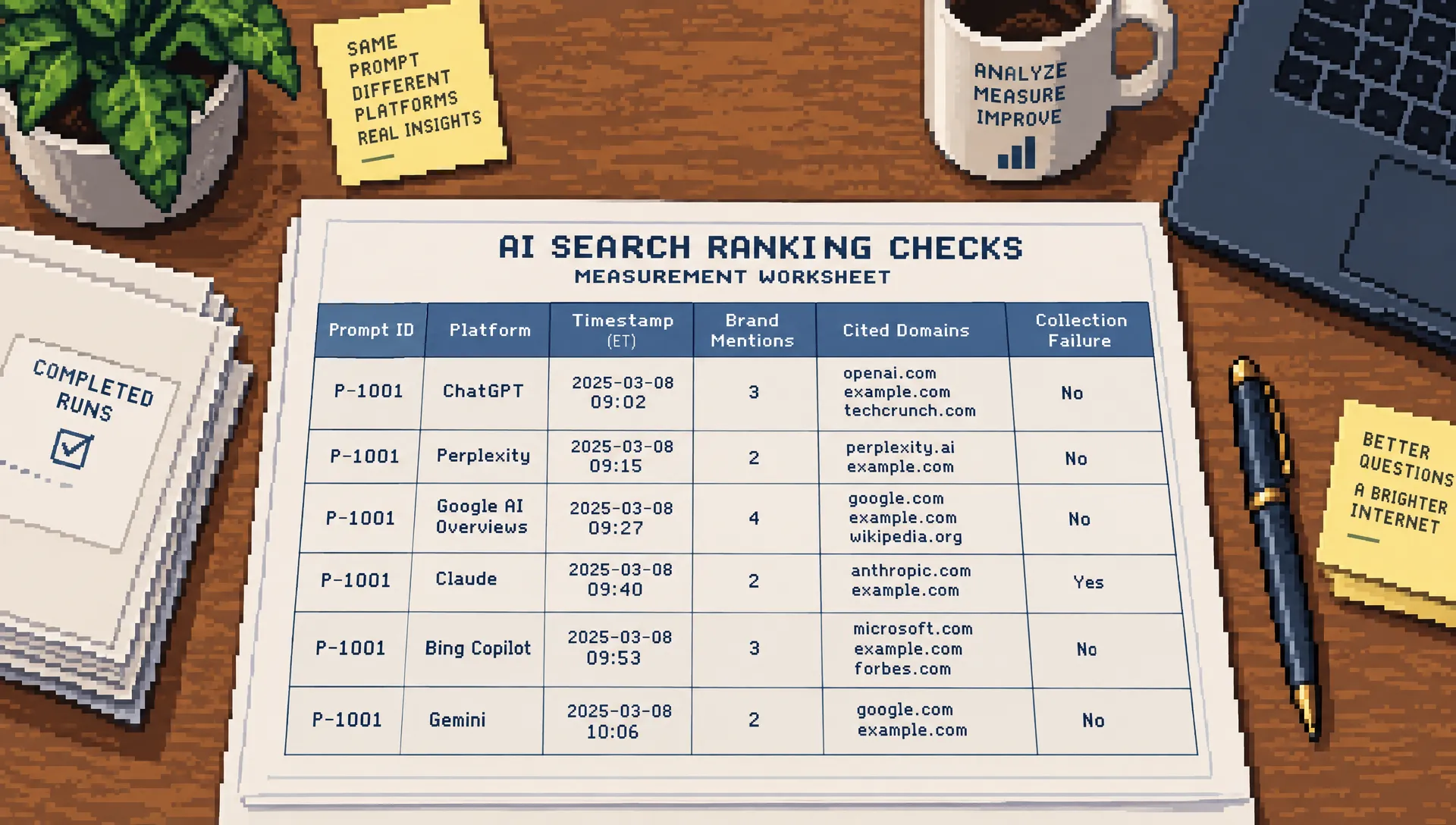
Save each prompt exactly, including punctuation, spelling, brand names and geographic constraints. Give every prompt a stable identifier so you can compare the same item over time.
Record the platform and product surface. A browser interface, an API response and a third-party tracker may use different settings or workflows. Do not assume that one represents another without validation.
For an AI search ranking baseline, also record the date and time, visible model or mode, language, location setting, login state and whether the conversation was fresh. Some details will be unavailable; mark those as unknown rather than filling them with assumptions.
A clean session reduces conversational carryover. It does not guarantee an identical backend configuration or remove every form of personalization.
Repeat within and across time windows
Start with a small exploratory batch to discover obvious instability. Five to ten repeats per prompt can expose changing answer formats or inconsistent citation extraction, but they are not a universal threshold for statistical confidence.
If a decision depends on the result, expand the sample based on observed variability, the size of the change you need to detect and your budget. Spread observations across multiple time windows rather than sending every request in one burst.
Repeated requests can share cached responses or other dependencies. A hundred checks performed close together should not automatically be treated as a hundred independent observations.
Keep automated collection within the platform’s terms and applicable rate limits. If a platform blocks or fails a request, record a collection failure rather than assuming the brand was absent.
Separate exact repeats from planned variations
Use one fixed prompt group to measure repeatability. Maintain another group for deliberate variations, such as adding a location, changing wording or specifying a budget.
When comparing AI search ranking before and after a content update, retain the baseline prompts and collection conditions. Rotate prompt order across collection windows so one group is not always measured at a different time from another.
Record the content change and deployment date. Allow for discovery and indexing rather than assuming the first post-publication answer reflects the update.
An unchanged comparison group can help identify broader platform movement. It does not prove causation, since prompts may be affected differently, but it is more informative than attributing every improvement to your latest edit.
Report visibility rates instead of a single screenshot
Suppose a hypothetical test contains 100 valid observations for a defined search surface. An AI answer appears in 80 observations, your brand appears in 40 and your domain receives a citation in 30.
These produce different metrics:
| Metric | Calculation | Result |
|---|---|---|
| AI-answer appearance rate | 80 ÷ 100 | 80% |
| Overall brand visibility rate | 40 ÷ 100 | 40% |
| Brand visibility when an AI answer appears | 40 ÷ 80 | 50% |
| Overall domain citation rate | 30 ÷ 100 | 30% |
| Domain citation rate when an AI answer appears | 30 ÷ 80 | 37.5% |
These figures are illustrative, not platform benchmarks. The denominator determines what each result means.
AI search ranking reports should distinguish overall opportunity from performance inside generated answers. A feature that does not appear is a valid absence for overall visibility, but it is not evidence that your page lost a citation contest inside an answer.
Track missing observations separately. A timeout, blocked request or broken parser is not a valid zero. Also report prompt-level results: a portfolio average can hide excellent coverage of one topic and no coverage of another.
Include uncertainty and concentration
A visibility rate is an estimate for the tested conditions, not a permanent property of your brand. Under a simple independent-observation assumption, 40 appearances in 100 trials gives an approximate 95% Wilson interval of 31% to 50%.
Real monitoring can violate that independence assumption because observations share prompts, time windows or service behavior. Treat a simple interval as an indication of uncertainty, not a guarantee about the wider audience.
When evaluating AI search ranking, inspect whether gains are distributed across prompts and days. Ten additional appearances concentrated in one prompt are different from improvements across ten distinct tasks.
Also define “share of voice” explicitly. A vendor might calculate it from mention counts, answer-level presence or weighted positions. Those formulas can produce different trends from the same underlying answers. Preserve the raw counts and denominator alongside any composite score.
Diagnose the type of change before reacting
Compare the underlying answers, not just the score. Four patterns suggest different investigations:
- Sources change but the conclusion stays similar: Investigate evidence selection and citation variability.
- The answer’s task or emphasis changes: Investigate ambiguity, query interpretation or session context.
- The AI answer stops appearing: Investigate feature availability separately from source inclusion.
- Your domain declines across prompts and time windows: Check technical accessibility, content changes and competing evidence before drawing conclusions.
A drop in AI search ranking across one noisy prompt is weak evidence of a website problem. A sustained decline across comparable prompts deserves closer inspection, especially if your pages have changed or become inaccessible.
Check whether the cited URLs still support the statements attributed to them. Citation presence alone does not establish accurate representation. Similarly, a brand mention can be unfavorable, outdated or incidental.
Use answer text, cited URLs and timestamps to classify what happened. Without that evidence, an alert tells you only that a detection rule changed state, not why visibility changed.
Check whether your tracking vendor measures the right thing
Before purchasing or trusting a monitoring tool, ask for its collection method and metric definitions. “We track ChatGPT” is incomplete without the product surface, browsing behavior, location controls and collection schedule.
Vendor-reported AI search ranking should be auditable against stored observations. Ask whether the tool preserves answer text, visible citations and collection timestamps, and whether it distinguishes failed checks from genuine absences.
Useful verification questions include:
- Coverage: Which interfaces and answer modes are actually tested, rather than inferred?
- Freshness: When was each answer collected, and can cached observations be identified?
- Detection: How are brand aliases, ambiguous names, subdomains and URL redirects handled?
- Validation: Can you manually inspect a sample of positive and negative detections against the captured answer?
A sample audit should look for false positives and false negatives. A company name that is also an ordinary word can trigger mistaken mentions. A citation may use a shortened link or alternate domain that a simplistic detector misses.
Validate recommendation order separately from citation order. A tool that reliably extracts source cards may still misread an unordered paragraph as a ranked list. No single accuracy percentage resolves every detection task.
Frequently asked questions
Does a disappearing citation mean my page was penalized? No. One missing citation does not establish a penalty. Compare repeated observations, check whether the answer’s scope changed and look for a sustained pattern before investigating a site-level problem.
How many times should I repeat a query? There is no universal count. Begin with a small exploratory batch, then increase coverage according to variability and decision risk. Additional prompts and time windows can be more informative than repeatedly testing one prompt in a single burst.
Can I make AI answers deterministic? Not reliably in most consumer search interfaces. Even where an API exposes generation controls, retrieval changes, model updates and service configuration can still affect reproducibility.
Should I track mentions, citations or traffic? Track them separately. Mentions measure answer-level presence, citations measure visible attribution and referral traffic measures identifiable visits. None alone captures business value. Our guide to assessing qualified traffic from AI search explains how to connect visits with meaningful outcomes.
What counts as an improvement? A stronger AI search ranking result is a sustained gain in a predefined metric across comparable observations. It becomes more useful when the gain covers commercially relevant prompts and the answers represent your business accurately.
Start with a baseline you can audit
Choose a bounded set of important prompts, define the visibility event and collect repeated observations under documented conditions. Preserve enough evidence to explain each result rather than storing only a score.
Before changing content in response to an alert, determine whether the movement reflects answer availability, retrieval, citation selection or detection error. Optimize against persistent patterns, not the last answer you happened to see.
Read more

How OpenAI Search Handles Paywalls and Subscriber Content
A paywalled article can appear in an AI answer without its full text being available. Learn how citations, publisher agreements and crawler controls differ, then protect subscriber content without hiding every useful preview.

How to Manage Your Privacy in ChatGPT Search
Turning off model training does not make web searches anonymous or erase saved information. Learn which settings control memory, location and chat retention, plus what to check before opening a result or searching with work data.

How ChatGPT and Google Handle Fresh Information
An answer can sound current while relying on old evidence. Learn how each platform finds updates, how to check time-sensitive claims and what publishers can do to make genuine changes easier to discover.