
How to Use AI Content Optimization to Refresh Old Articles
Use AI content optimization to refresh old articles, fix content gaps, verify facts and measure gains in search visibility and qualified traffic.

An old article does not need a rewrite just because its traffic has slipped. It may need a clearer answer, a corrected recommendation or a better match for what readers now want. AI content optimization helps you identify and make those changes faster, provided you give the model evidence rather than asking it to guess.
The goal is not to make every article longer or sprinkle in more keywords. It is to improve an existing page’s usefulness while preserving what already works. Here is a repeatable workflow, from choosing the right article to measuring the update.
1. Select articles with recoverable business value
Start with your content inventory and Google Search Console data, not an AI-generated list of topics. Look for pages that serve a relevant audience and have a specific, fixable weakness.
Useful candidates include articles losing clicks for previously relevant queries, pages earning impressions without answering the underlying question and guides whose screenshots or recommendations are outdated. A page supporting a valuable product or service can also deserve attention despite modest traffic.
Use a simple screening table:
| Signal | What to investigate | Possible refresh |
|---|---|---|
| Clicks decline while impressions remain steady | Query mix, position changes and search-result presentation | Improve intent alignment and the search snippet |
| Impressions grow for an adjacent question | Whether that question belongs within the article’s scope | Add a focused answer or example |
| Traffic arrives but few visitors take the next step | Audience fit and relevance of the offer | Improve decision support and the call to action |
| Examples or instructions are outdated | Whether readers can still complete the task | Replace obsolete information and retest instructions |
These are diagnostic signals, not proof that content caused the problem. Technical issues, seasonality and changing search results can produce similar patterns.
Prioritize AI content optimization where a better answer can plausibly improve a business outcome. This principle also underpins optimizing existing content for greater commercial impact (a Dutch-language B2B guide), rather than increasing publishing volume by default.
Choose one page for the first refresh. A controlled pilot makes editorial review and measurement easier.
2. Diagnose what changed before editing
Record the page’s current job in one sentence: who it helps, what question it answers and what the reader should be able to do afterward.
Then compare that job with the evidence available today. Review the page’s Search Console queries, inspect relevant search results and check the sources behind its main claims. Search-result pages can reveal changed expectations, but competing articles are not factual authorities simply because they rank.
Separate the problem into three categories:
- Accuracy gaps: Outdated facts, broken instructions or unsupported recommendations.
- Intent gaps: The article answers a different question from the one visitors are asking.
- Decision gaps: Readers understand the topic but lack the criteria or examples needed to act.
For example, an agency software guide may explain task management thoroughly while barely addressing client approvals or billable time. If relevant query data and customer questions support those needs, they belong in the diagnosis.
Use AI content optimization to compare the draft against this evidence, not to manufacture reasons for changing it. Supply the article, query groups and verified reference material, then ask the model to identify mismatches.
Account for the reader’s stage, too. As AI search changes the customer journey, a broad educational page and a purchase-validation page may need very different updates.
If the emerging intent is fundamentally different, create a separate page rather than forcing the old article to serve both purposes.
3. Build a constrained refresh brief
Before generating copy, decide what the model may change. This prevents a common failure: replacing a distinctive article with a polished but generic version.
Keep useful original research, tested instructions and expert observations. Preserve sections that already answer important questions well. Flag passages where product capabilities, prices or legal requirements need confirmation from an authoritative source.
Give the model an evidence packet containing the existing article, relevant query data, approved product information and source excerpts. Include the page’s objective and intended audience. If your tool cannot browse, do not expect it to verify current facts independently.
A reusable prompt can look like this:
Act as an editor refreshing an existing article, not writing a replacement.

Audience: [specific reader]
Page objective: [question answered and desired next action]
Existing article: [paste text]
Relevant query groups: [paste data]
Verified source excerpts: [paste material with source URLs and dates]
Must preserve: [original evidence, examples and useful sections]

Identify accuracy gaps, intent gaps and missing decision support.
Recommend only changes supported by the supplied material.
Do not invent statistics, quotations, product features or source URLs.
Mark unsupported factual claims as NEEDS VERIFICATION.

Return a diagnosis and a section-level edit plan first.
For each proposed change, explain the reader benefit and evidence.
Do not rewrite the article until the plan is approved.
The strongest AI content optimization brief defines what success looks like before drafting starts. “Help agency owners compare approval workflows” is actionable. “Make this more comprehensive” invites unnecessary expansion.
Review the proposed plan yourself. Reject additions that repeat another page, distract from the main task or depend on evidence you do not have. Then request revised sections individually so you can inspect each meaningful change.
4. Rewrite around answers, examples and decisions
Make the smallest set of changes that resolves the diagnosis. Sometimes that means replacing a weak introduction and adding one example. Sometimes it requires rebuilding an obsolete section.
Begin important sections with a direct answer, then explain the conditions and trade-offs. Use headings that describe genuine reader questions rather than repeating variations of the same keyword.
Consider this hypothetical passage in an agency software guide:
Before: “The best project management platforms improve collaboration and streamline workflows for modern teams.”
After: “If clients approve deliverables, check whether they can comment and approve work without a paid team account. Test one approval cycle with an external user before choosing a platform.”
The revision adds a concrete evaluation criterion without inventing a vendor capability. This is where AI content optimization is most useful: turning vague language into specific guidance grounded in the page’s purpose.
Add supporting material only when it earns its place. A worked example can explain a process. A comparison table can expose trade-offs. A short checklist can help readers complete a task. None is automatically better than a clear paragraph.
For AI-powered search, make key passages understandable outside their immediate surroundings. Name the subject, state the relevant conditions and attach the source to the claim it supports. Avoid answers that rely on an unexplained “this” or “it” from several paragraphs earlier.
Clear passages make information easier to interpret and reuse, but they do not guarantee a citation. Keep the article useful for the person reading the whole page, not just a system extracting a sentence.
5. Fact-check AI content optimization before publishing
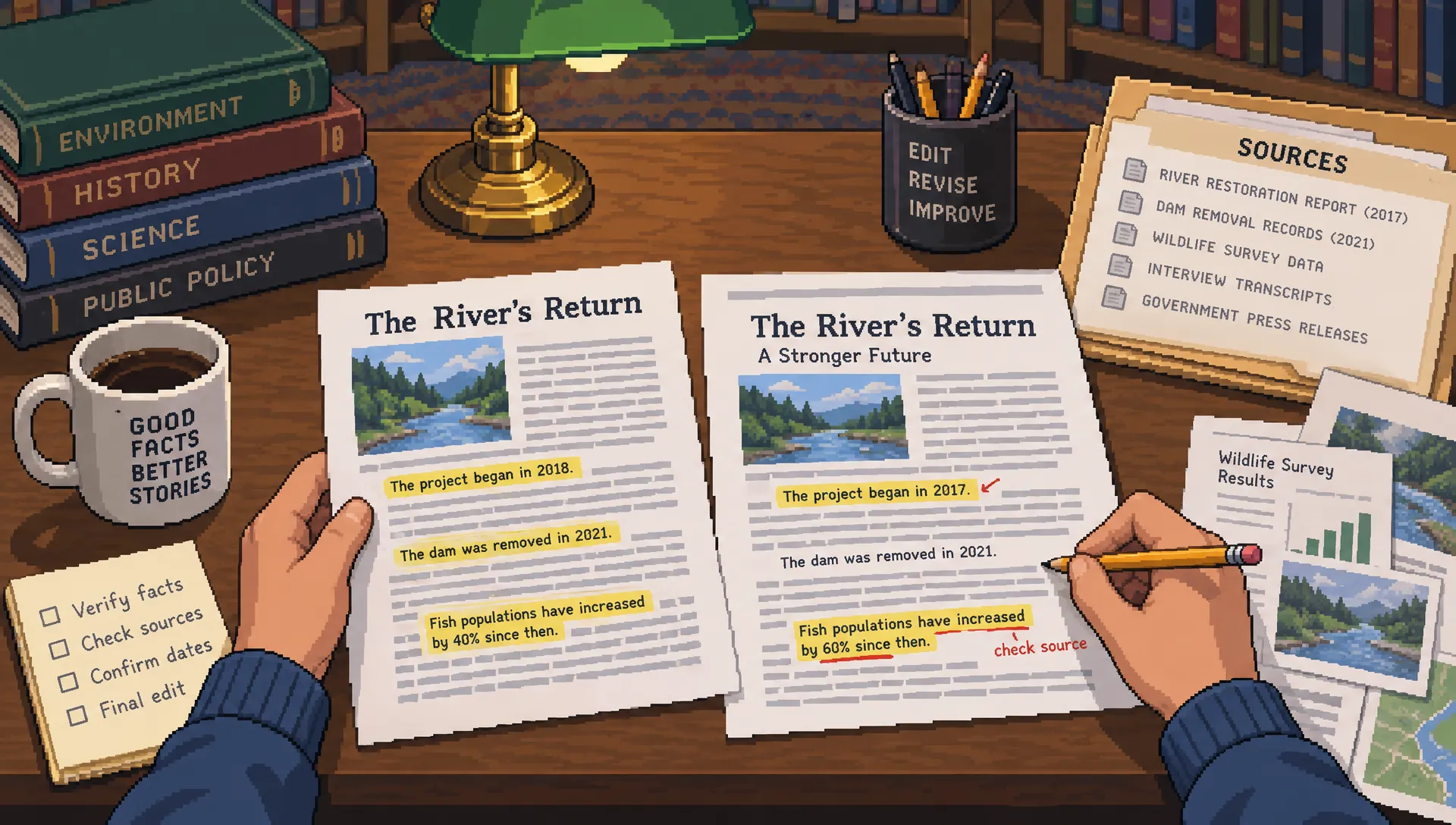
Treat generated revisions as drafts. Fluency is not evidence, and a plausible reference may still be nonexistent or fail to support the claim beside it.
Open every new source. Confirm that it supports the exact assertion, applies to the relevant market or product version and is recent enough for the subject. Where possible, use original documentation or research rather than an article summarizing another article.
Pay particular attention to prices, numerical claims, vendor comparisons and instructions. If a claim cannot be verified, remove it, qualify it accurately or replace it with a supported observation. Do not publish an unresolved verification marker.
Also compare the revised article with the original. Check that AI has not removed exceptions, changed the meaning of a quotation or replaced a firsthand observation with a broader unsupported claim.
Google’s people-first content guidance emphasizes original information and substantial value. It also cautions against changing dates merely to make content appear fresh when it has not substantially changed.
Use that as an editorial test: can you point to what a reader can now understand or accomplish that they could not before? If the answer is only “the wording sounds newer,” the refresh is not finished.
6. Publish without disrupting the existing page
A content refresh normally belongs at the existing URL. Changing the slug simply because the article has improved introduces migration work without an obvious reader benefit.
Before publishing, compare the live page with the approved draft. Confirm that its canonical URL is correct, it remains indexable and important internal links still work. If a URL change is genuinely necessary, plan the redirect and update internal references rather than treating it as a cosmetic edit.
Review the title and meta description against the revised content. They should set accurate expectations, not promise an answer the page still does not provide. Replace broken links and update images whose interfaces or instructions have become obsolete.
Internal links should support the reader’s next task. Link from relevant existing pages to a substantially improved guide where useful, and connect that guide to deeper resources without adding a block of unrelated links.
Keep technical expectations realistic. Google’s guidance on AI search features says there are no additional technical requirements or special schema needed for AI Overviews or AI Mode beyond normal Search eligibility. Eligibility still does not guarantee inclusion.
AI content optimization does not remove the need for a final publishing check. Inspect the rendered page on mobile and desktop, test its main call to action and confirm that analytics events still fire.
Finally, record the publication date and a short change log so later results can be interpreted against what actually changed.
7. Measure the refresh against its original purpose
Capture a baseline before publishing. A recent 28-day period can be a useful starting point, but compare equivalent periods and account for seasonality. Low-traffic pages may need a longer window before patterns become meaningful.
Track the page and the query groups you intended to improve. Aggregate traffic can hide a useful gain in one topic alongside a loss in another.
| Intended improvement | Useful measures | Interpretation check |
|---|---|---|
| Better match for existing searches | Clicks, impressions, CTR and position for relevant queries | Has the query or device mix changed? |
| Coverage of a missing question | Visibility and clicks for that query group | Are the new searches relevant to the page’s purpose? |
| Better decision support | Relevant CTA clicks and completed conversions | Is the audience qualified, and does tracking work? |
| Greater AI-search visibility | Identifiable referrals and citations observed in defined checks | Could personalization or attribution gaps affect the result? |
Inspect indexing and tracking soon after publication. Review performance over subsequent weeks rather than declaring success after a day or two. Search volatility, other site changes and demand shifts can all affect results.
Judge AI content optimization by improved reader and business outcomes, not by the model’s content score. A longer article or higher optimization score is an editorial input, not proof of performance.
For a broader scorecard, use search optimization metrics beyond rankings to connect visibility with qualified traffic and conversions.
Keep a record of the original diagnosis, edits and outcomes. That history helps you decide which kinds of refresh deserve repeating across the site.
Frequently asked questions
Should I refresh every old article? No. Age alone is not a problem. Prioritize pages with relevant demand, business value and a fixable weakness. Accurate evergreen articles may need little attention, while obsolete or overlapping pages may need consolidation rather than another rewrite.
Can AI content optimization improve rankings? It can help you identify gaps and produce more useful revisions, which may support search performance. It cannot guarantee rankings. Results also depend on competition, technical accessibility, search intent and whether the changes genuinely improve the page.
How much of an article should I rewrite? Rewrite only what the diagnosis supports. Preserve useful original material and strong explanations. A targeted correction can be more valuable than replacing the entire article, especially when a full rewrite removes specific experience or changes its focus.
Should I change the publication date after a refresh? Use an updated date when a substantive revision justifies it, and follow your site’s editorial policy. A date change should reflect real work, not imply that unchanged information has been checked or renewed.
Can a clearer article earn citations in AI answers? Clear, well-supported content can be easier to interpret, but no format guarantees citations. Treat observed citations as one visibility signal and continue measuring whether the article helps relevant visitors take useful next steps.
Start with one evidence-led refresh
Choose a page with a clear weakness, capture its baseline and ask AI for a diagnosis before requesting new copy. Publish only the changes you can justify and verify.
Once that process works, connect it to your broader AI search strategy. Scaling a tested editorial workflow is more useful than scaling rewrites.
Read more
How Google AI Search Changes the Customer Journey
Customers can compare options and form a shortlist before they reach your website. Learn where Google’s AI experiences change that journey and how to create content, proof and conversion paths that support the next decision.

Is AI Search Sending Your Website Qualified Traffic?
AI referrals can look impressive without producing customers. Learn how to separate trackable visits from hidden influence and measure buyer fit, qualified leads and revenue before investing more in visibility.

Search Optimization Metrics That Matter Beyond Rankings
A higher ranking can hide weaker traffic and fewer customers. Learn which metrics connect organic search and AI citations to qualified visits, conversions and revenue, plus how to build a scorecard that supports better decisions.