
How to Use AI for YouTube SEO Without Keyword Stuffing
Use YouTube SEO AI to research intent, improve titles and captions, compare tools and measure results without keyword stuffing.
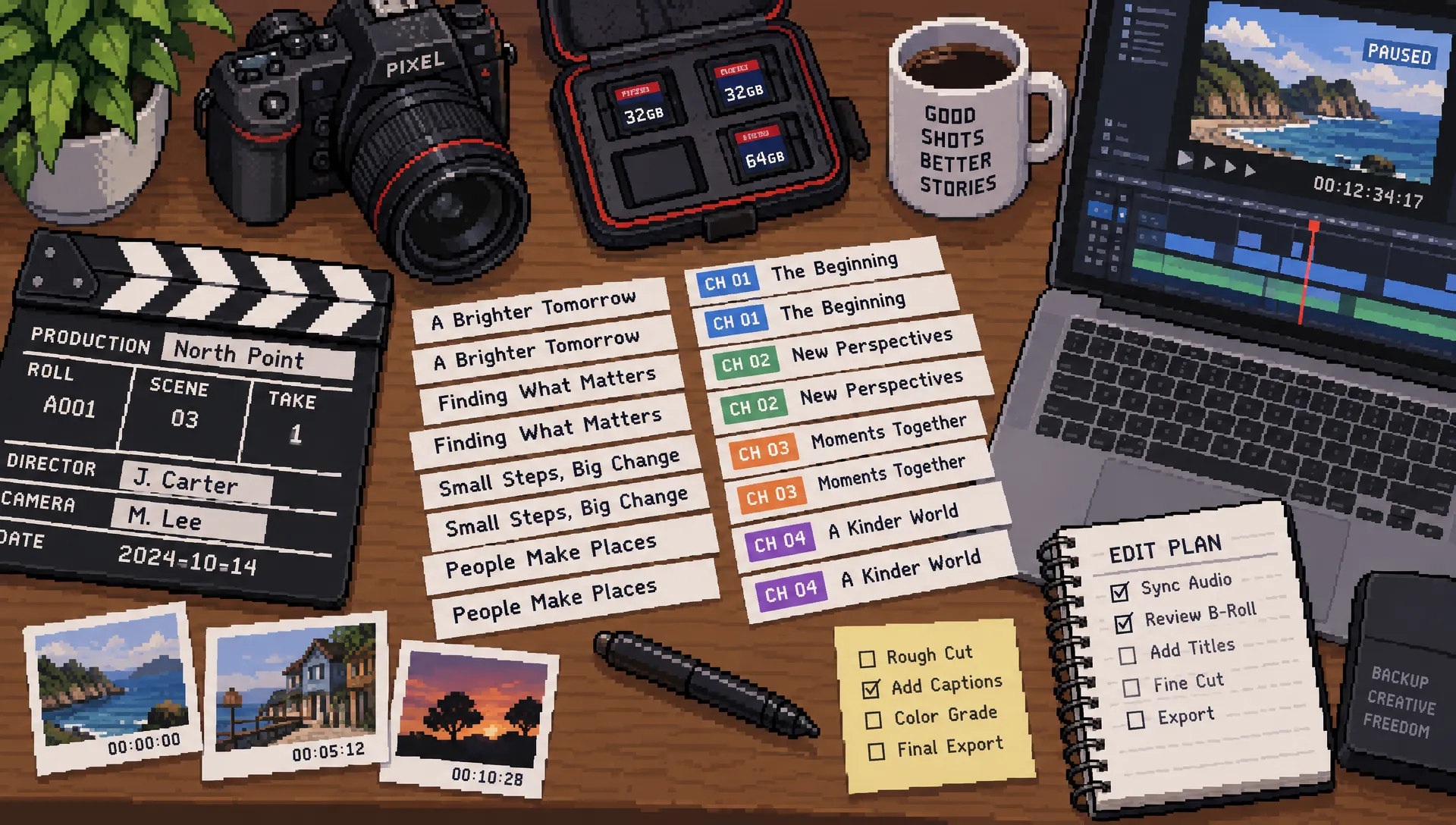
A good YouTube SEO AI workflow helps the right viewer recognize a video that answers their question. It should not turn your title, description and transcript into variations of the same keyword. Use AI to organize audience research, draft accurate metadata and identify gaps, then have a person verify the recommendations against the actual video.
This guide explains how to build that workflow, compare tools without trusting their marketing claims and measure whether changes help. The starting point is viewer intent, not a keyword-density target.
Separate YouTube’s guidance from tool predictions
YouTube search and recommendation surfaces are not interchangeable. Search starts with a query. Home and Suggested Videos operate in different viewing contexts, so a tactic that improves search relevance does not automatically increase recommendation traffic.
YouTube’s performance and discovery guidance explains that search considers how well a video’s title, description and content match a query, alongside engagement for that search. It does not provide a universal keyword density, a public ranking formula or a guaranteed optimization score.
The platform’s guidance on video tags also says tags play a minimal discovery role except where terms are commonly misspelled. That makes extensive AI-generated tag lists a poor use of review time.
Treat YouTube SEO AI scores as a tool’s assessment, not a measurement supplied by YouTube. A score can help you spot missing information, but it cannot establish that a video will rank.
Keep three categories separate: official platform guidance, observations from your own channel and vendor hypotheses. Each can inform a decision, but they carry different levels of evidence.
Find the viewer’s task before choosing keywords
Start with questions your audience actually asks. Useful inputs include YouTube search terms in your channel analytics, relevant comments, customer questions and search suggestions. Record where each query came from so AI-generated ideas do not quietly become “audience data.”
Ask AI to group those queries by the task behind them. “XLOOKUP tutorial,” “XLOOKUP not working” and “XLOOKUP versus VLOOKUP” concern the same feature, but they call for a lesson, troubleshooting and a comparison respectively.
Our guide to grouping keywords by search intent explains the classification process. For video planning, add one requirement: identify what the viewer needs to see demonstrated.
This distinction matters particularly in sensitive topics. A health channel should not merge “psychiatric evaluation” and “neuropsychological testing” into one interchangeable service simply because a practice offers both. The descriptions of psychiatric evaluations and neuropsychological testing illustrate why related care options still need accurate labels and distinct explanations.
Your YouTube SEO AI research should end with one primary viewer task per video, plus closely related questions the video genuinely answers.
For competitor research, inspect a small set of relevant results. Compare their promises, demonstrations and unresolved questions. Do not assume their visible keywords caused their performance, and do not copy their wording.
Build a transcript-first YouTube SEO AI workflow
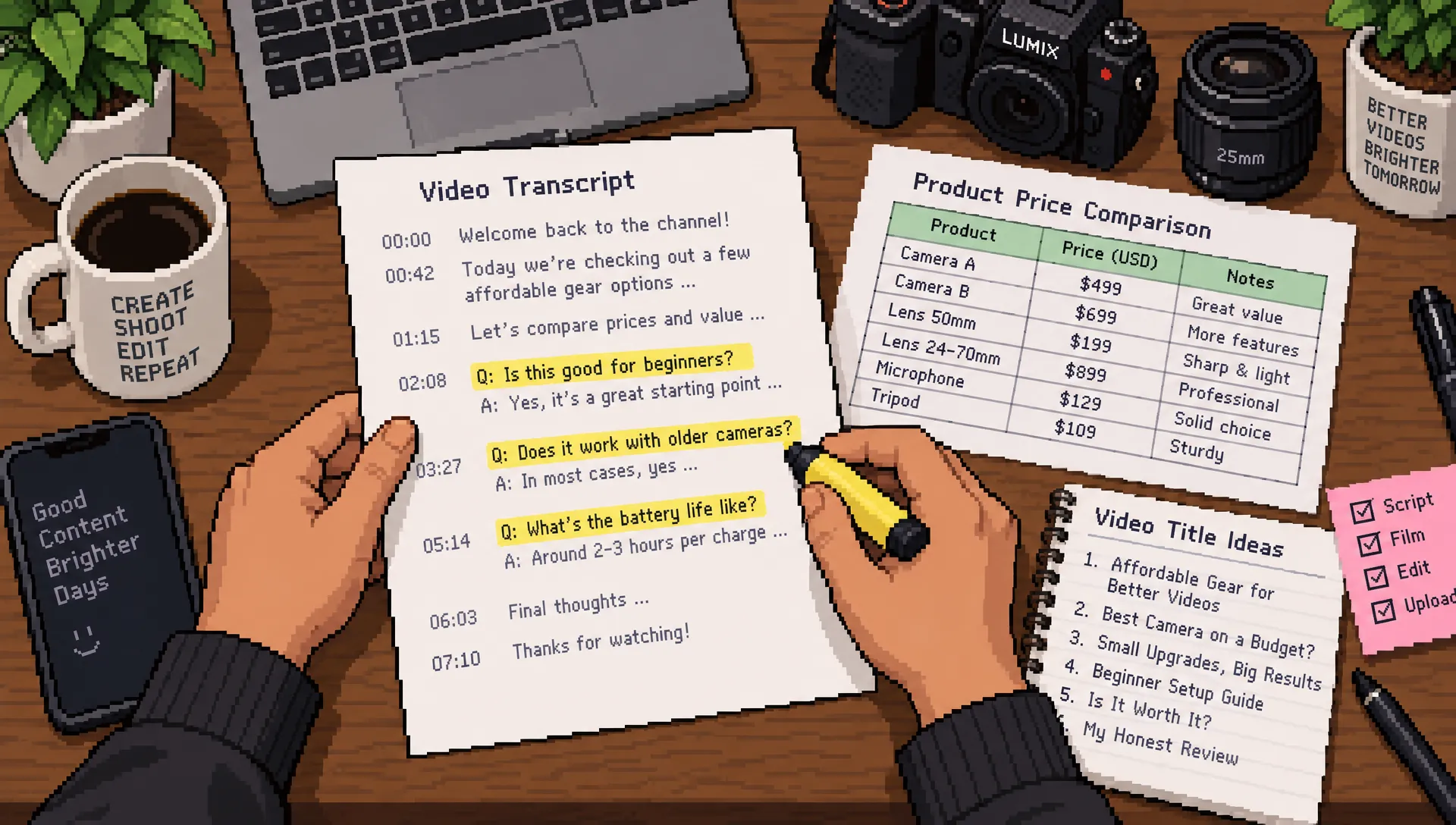
The safest drafting input is the video itself. Give your model a corrected transcript, a short audience description and any verified product names or technical terms. Add timecodes if you want help with chapters.
An outline can help before recording, but it is not proof of what the finished video contains. If the edit removes a demonstration, the metadata must stop promising it.
Use a constrained prompt rather than asking the model to “optimize everything”:
Using only the supplied transcript, identify the main viewer task and supporting questions. Draft three accurate titles, a two-sentence description opening and chapter labels where timecodes support them. For each promise, identify the supporting transcript passage. Flag missing evidence instead of inventing benefits, statistics or demonstrations. Avoid repeated keyword variants and unsupported superlatives.
Keep the source passages in your working document, not necessarily in the published description. They give the reviewer a quick way to check whether the proposed wording is justified.
If the model identifies a useful question the video never answers, choose between revising the video and dropping the promise. Adding the question to the description alone does not close the content gap.
Write titles and descriptions that match the demonstration
Suppose your video shows beginners how to use XLOOKUP with a product-price table, including what happens when a match is missing. A clear title would be:
Excel XLOOKUP for Beginners: Match Products to Prices
A description opening could say: “Learn how to use XLOOKUP to find a product’s price in an Excel table. This walkthrough also shows how to handle a missing match.”
Both pieces describe the assumed demonstration. Neither needs a string of near-identical phrases or an unsupported claim that this is the “ultimate” tutorial.
Ask your YouTube SEO AI assistant for distinct options: one emphasizing the task, one emphasizing the audience and one emphasizing the demonstrated outcome. Reject alternatives that change the substance just to sound more clickable.
The thumbnail should complement the title. For this example, a readable before-and-after table could communicate the task more clearly than repeating the entire title in small text. A compelling promise is useful only if the video delivers it.
Put supporting resources, relevant links and necessary disclosures below the description opening. Do not use that space as a keyword warehouse.
Improve captions and chapters without rewriting reality
AI can help detect transcription errors, inconsistent terminology and potential chapter boundaries. Review names, formulas, abbreviations and technical vocabulary carefully because a plausible transcription error can change the meaning of a lesson.
Captions should represent what was said. Do not insert search phrases into captions that the speaker never used. If the spoken explanation is unclear, improve the recording or add an appropriate clarification rather than falsifying the transcript.
Chapters should describe meaningful transitions. Verify that every suggested timestamp lands at the relevant segment, then check the labels in the published player. A timecoded transcript is useful input, but it does not eliminate synchronization errors.
For multilingual content, review translated titles and captions with someone who understands the subject and the target language. Literal translations can miss the terminology viewers actually use.
Use YouTube SEO AI to make the existing content easier to understand and navigate. Do not assume that adding chapters or captions guarantees a ranking increase; their practical value also includes accessibility and a better viewing experience.
Compare AI tools using the same test video
A fair comparison starts with identical inputs. Give each candidate tool the same transcript, target audience, query set and constraints. Save the outputs before editing them so you can compare the systems rather than your own revisions.
Choose a test video that contains an ambiguous term, a technical name and a question it deliberately does not answer. That combination reveals whether a tool understands context or simply produces confident copy.
| Test area | What to examine | Warning sign |
|---|---|---|
| Content fidelity | Every title promise has transcript support | Invented demonstrations or outcomes |
| Intent matching | Suggestions address the intended viewer task | Unrelated, high-volume terms dominate |
| Metadata quality | Titles are distinct and descriptions read naturally | Repeated variants and generic claims |
| Evidence quality | Data sources and limitations are explained | Undocumented scores presented as certainty |
| Review effort | Outputs can be checked and exported efficiently | Attractive copy requires extensive correction |
When evaluating YouTube SEO AI tools, ask where keyword estimates come from and whether they describe YouTube specifically. A model suggesting phrases is not the same as a provider measuring search demand.
Record review time and corrections alongside subscription cost. A tool that produces more alternatives may still be less useful if most of them misrepresent the video. There is no need to buy a specialist product before testing whether your existing tools meet these requirements.
Protect scripts, channel data and other people’s work
Before uploading material, check the provider’s retention, training-use, deletion and access terms. Confirm which terms apply to your specific account or plan rather than assuming that every version of a product has identical protections.
A YouTube SEO AI workflow rarely needs your complete customer database, private messages or unrestricted channel access. Remove unnecessary personal information, and use the smallest dataset that supports the task.
For healthcare, legal and financial channels, do not paste identifiable client or patient material into a general-purpose tool without appropriate authorization and safeguards. A de-identified example may still contain details that reveal someone’s identity.
Check rights as well as privacy. Having access to a competitor’s video does not mean you can freely reuse its transcript, music or footage. Use authorized material and limited excerpts where permitted, and check generated recommendations for copied phrasing.
If a tool requests account access, inspect the permissions and revoke access when it is no longer needed. Keep a human approval step before publishing or changing live metadata.
Measure improvement without confusing correlation with cause
Match the metric to the problem
Define the problem before making changes. A video with little search traffic presents a different question from one that earns impressions but fails to attract clicks. Neither diagnosis automatically calls for more keywords.
Track metrics that relate to your hypothesis:
- Search traffic and search terms: Is the video being found for relevant viewer tasks?
- Impressions click-through rate: When eligible impressions are recorded, does the packaging attract clicks?
- Watch time and audience retention: Does the viewing experience sustain the promise that attracted the audience?
- Relevant audience actions: Are viewers taking the next step that matters for this video?
Keep traffic sources separate where reporting permits. A channel-wide click-through rate can change because the mix of Search, Home and other traffic changes, even when the title has not improved. Impressions-based CTR also does not cover every possible view.
Evaluate YouTube SEO AI changes against a written hypothesis, such as: “A more specific title will attract beginners looking for a product-price lookup demonstration.” That is more informative than “the optimization score should go up.”
A higher CTR with weaker retention can indicate an overstated promise or a different audience mix. It deserves investigation, not an automatic declaration of success.
Keep a change log and acknowledge confounders
Record the original metadata, the revision, the date and the reason for the change. Use comparable observation windows and note external events such as promotions, seasonal demand or a newly popular topic.
When diagnosing an existing video, avoid changing the title, thumbnail, description and opening simultaneously if you want to understand which change helped. A before-and-after comparison still cannot isolate causality completely because audience demand changes over time.
If an official experiment is available for your channel and the element you want to test, review its methodology and reported outcome before interpreting it. Otherwise, describe your analysis as observational.
For new uploads, compare videos with similar topics, formats, lengths and audience purposes. Treat the comparison as directional because those videos are never perfectly matched. Small channels may need longer observation periods; a tiny number of impressions cannot support a confident conclusion.
Your YouTube SEO AI process should preserve useful observations, including failed hypotheses. Keep a revision only when the evidence and content accuracy support it. Do not manufacture certainty from a small percentage change.
Frequently asked questions
Can AI-generated YouTube videos be monetized? AI use alone does not determine eligibility. YouTube’s channel monetization policies include requirements concerning original, authentic content and reused content. Check the current rules and any applicable synthetic-content disclosure requirements before publishing.
How many keywords should a video description contain? There is no universal count that makes a description effective. State the video’s main subject clearly, then include supporting details where they help viewers. Repetition is not a substitute for answering the query in the video.
Do AI-generated tags improve rankings? Generating tags does not create a ranking advantage by itself. Tags can help with relevant spelling variants, but YouTube says they otherwise play a minimal discovery role. Prioritize an accurate title, description and video.
Can YouTube SEO AI guarantee more views? No. Tools can assist with research, drafting and analysis, but they cannot guarantee audience demand, ranking or viewer satisfaction. Judge them by accuracy, saved review effort and measured outcomes rather than promises.
Start with one video and a reviewable process
Choose one useful video, document its viewer task and test transcript-grounded revisions. Keep the changes accurate and the measurement narrow enough to interpret.
To make this repeatable, build an AI workflow with human review. Automate the drafting and organization, while keeping people responsible for promises, evidence and publication.
Read more

How OpenAI Search Handles Paywalls and Subscriber Content
A paywalled article can appear in an AI answer without its full text being available. Learn how citations, publisher agreements and crawler controls differ, then protect subscriber content without hiding every useful preview.

How to Manage Your Privacy in ChatGPT Search
Turning off model training does not make web searches anonymous or erase saved information. Learn which settings control memory, location and chat retention, plus what to check before opening a result or searching with work data.
How ChatGPT and Google Handle Fresh Information
An answer can sound current while relying on old evidence. Learn how each platform finds updates, how to check time-sensitive claims and what publishers can do to make genuine changes easier to discover.