
How to Choose an AI Search Engine for Business Research
Choose an AI search engine for business research with a practical scorecard for citations, privacy, cost and reliable results.

Choosing an AI search engine for business research is less about finding the most fluent assistant and more about finding answers your team can defend. A convincing summary is not enough when it informs a supplier shortlist, market forecast or investment decision. You need traceable evidence, appropriate data protections and a workflow that saves time after fact-checking, not just before it.
Choose the tool that produces the most useful, verifiable research under your actual working conditions. A structured trial will reveal more than a feature comparison or a vendor demonstration.
Define the research decision first
Start with the decision the research must support. “Research the logistics market” is too broad to evaluate meaningfully. “Identify three logistics providers that serve these countries and document their published capabilities” gives reviewers something concrete to check.
Write down the required geography, publication dates, source types and deliverable. Decide whether an acceptable answer needs official documentation, independent reporting, financial filings or licensed market data. A tool that excels at finding public product information may struggle with a question whose evidence sits behind subscriptions.
Also define the cost of an error. An incorrect brainstorming suggestion is different from an unsupported claim in a board presentation. Higher-stakes work needs stronger source requirements and human review, regardless of the platform.
Choose an AI search engine for the data you need
Consumer web research and enterprise search solve different problems. Web-oriented tools retrieve public information and synthesize answers. Enterprise search platforms connect to organizational content, ideally respecting the permissions already applied to those documents.
Products such as Glean and Microsoft 365 Copilot belong on a different evaluation track when the central question is about internal knowledge. Their suitability depends on connectors, configuration, permissions and the systems your organization uses. Do not assume that a familiar product name guarantees access to every repository.
Some research workflows need both categories. For example, evaluating a supplier may require public financial information alongside confidential procurement notes. In that case, assess how information crosses between systems and whether each environment is approved for that data.
A platform that cannot access the necessary evidence is not a good fit, however polished its answer sounds.
Build a shortlist around workflows, not rankings
The following tools are reasonable candidates for a public-web research trial. This is a shortlist, not a ranking or a claim that their plans offer equivalent capabilities.
| Candidate | Research workflow to test | Question to resolve during the trial |
|---|---|---|
| Perplexity | Source-linked discovery and follow-up research | Do cited pages support the specific claims your team needs? |
| ChatGPT search | Web research followed by synthesis and drafting | Does the selected mode retrieve current evidence and preserve its limitations? |
| Google Search AI experiences | Discovery alongside conventional search results | Is the required AI experience available for your account, region and queries? |
| Microsoft Copilot | Conversational web research | Which research functions are included in the exact product and plan being evaluated? |
Before testing an AI search engine, confirm current availability, sign-in requirements, usage limits and regional access. Record the plan, selected mode and test date. Capabilities can differ between free access, individual subscriptions and organizational contracts.
Keep conventional search in the comparison. For a narrow question requiring one authoritative document, searching directly may be faster than reviewing a generated answer.
Run the same research questions through every tool
Build a test set from real work, using public or approved information. Include straightforward lookups and questions that require synthesis. Eight to twelve prompts can provide a useful starting sample, though they will not establish performance across every research domain.
Use identical prompts in fresh conversations. Follow-up conversations should be a separate test because earlier answers can influence later responses.
| Test task | Example prompt | What to assess |
|---|---|---|
| Current fact lookup | “As of [date], find Company A’s latest reported annual revenue. Cite the filing and specify the fiscal period and currency.” | Correct entity, reporting period and primary source |
| Supplier comparison | “Compare these three providers against these five requirements. Mark capabilities as unknown when public evidence is missing.” | Consistent criteria and willingness to leave gaps |
| Market sizing | “Find two estimates for this market. Explain differences in geography, definition and forecast year.” | Comparability rather than a falsely precise average |
| Conflicting evidence | “Investigate this disputed claim. Present supporting and contradictory evidence with publication dates.” | Balanced retrieval and appropriate uncertainty |
Ask the AI search engine to separate documented facts, calculations and interpretation. Request explicit disclosure when it cannot access a source or when evidence is insufficient.
Record the complete answer and its citations, not just a screenshot of the summary. Repeat important prompts in separate sessions to see whether the core findings remain defensible. Different wording is acceptable; unexplained changes in facts are not.
Verify claims, not just the presence of citations
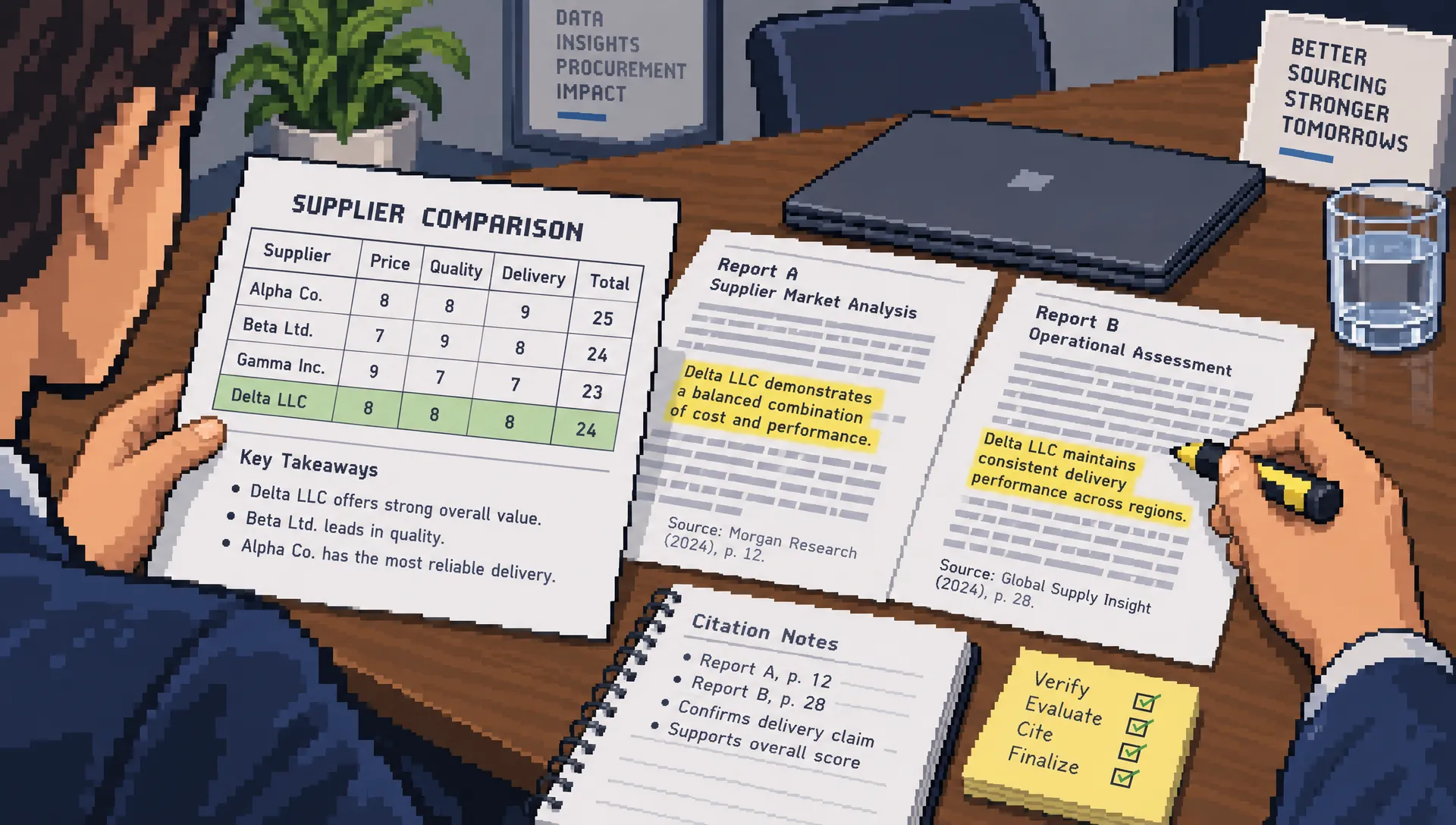
A citation is a route to evidence, not proof that the answer is correct. Open the underlying page and locate the passage supporting the claim. Check the organization, date, market definition and reporting period.
For each decision-critical statement, distinguish three outcomes: the source supports it, supports only part of it or does not support it. Treat an inaccessible source as unverified until someone can inspect it. A search snippet may omit qualifications that change the meaning.
Watch for citation chains. Several articles repeating the same press release are not independent confirmation. Similarly, a forecast published recently may still rely on older inputs. Our guide to how generative search selects sources to cite explains why source selection deserves scrutiny alongside the generated answer.
An AI search engine should also preserve the boundary between evidence and inference. If two vendors publish different pricing structures, the tool should not invent a directly comparable annual total without stating its assumptions.
Measure citation quality against the claims that matter to your decision. Counting links rewards citation volume; checking support rewards useful research.
Use a weighted scorecard with hard exclusions
Score each candidate against the same rubric. The weights below are a suggested starting point, not an industry benchmark. Adjust them before testing so preferences do not shift to favor a tool you already like.
| Criterion | Suggested weight | What a high score requires |
|---|---|---|
| Evidence accuracy | 30% | Important claims are supported by appropriate sources |
| Task coverage | 20% | Required questions are answered or clearly marked unresolved |
| Freshness | 15% | Evidence fits the requested date and reporting period |
| Repeatability | 15% | Repeated tests retain defensible core findings |
| Review effort | 10% | Researchers can validate the answer efficiently |
| Workflow fit | 10% | Follow-ups, exports and handoffs suit the team’s work |
Rate each criterion from zero to five, then calculate sum(weight × rating ÷ 5) for a score out of 100. For example, four out of five on a criterion weighted at 30% contributes 24 points.
Do not let an AI search engine compensate for an unacceptable security policy with a high usability score. Establish hard exclusions for prohibited data handling, failed permissions or unsupported decision-critical claims. A weighted average should compare acceptable candidates, not excuse disqualifying weaknesses.
Check privacy, permissions and access before uploading
Public-web research does not necessarily require confidential inputs. Often, a researcher can replace a client name with an industry description or remove commercially sensitive figures without weakening the question.
For sensitive work, review the exact product and contract with your security or legal team. Establish whether prompts, uploads and outputs may be used for model improvement, how long they are retained and which administrative controls are available. Account-level settings are not a substitute for an organizational approval process.
Vendor documentation, such as OpenAI’s data controls FAQ, is a starting point for checking applicable settings. Verify the terms for the actual service being purchased rather than transferring assumptions between consumer and business offerings.
For connected enterprise systems, test permissions using authorized test accounts. A user who cannot open a restricted document should not receive its sensitive contents through a generated answer or summary.
Before approving an AI search engine, also test access from the locations where employees work. Check whether authentication, regional restrictions or usage caps interrupt a normal research session. Evaluate these conditions without bypassing organizational security controls.
Compare total research cost, not subscription price alone
The meaningful unit of cost is a usable research deliverable. Subscription charges matter, but so do researcher time, source access, administrative work and correction effort.
Track the minutes spent prompting, opening sources, correcting claims and preparing the final handoff. Keep the task scope consistent. A short answer that omits half the requirements should not appear more efficient than a complete answer.
A practical calculation is:
Cost per approved brief = allocated tool cost + research and review labor + additional source-access costs
Use your organization’s actual costs rather than hypothetical savings claims. Record failed attempts as well as successful ones, since retries consume staff time and may count against usage limits.
The cheapest AI search engine may become the most expensive option if reviewers repeatedly reconstruct its reasoning. Conversely, a higher-priced plan is not automatically worthwhile if its additional functions do not improve your team’s tested tasks.
Compare median completion time and the spread between easy and difficult assignments. A tool that performs well only on straightforward questions may not reduce the bottleneck you are trying to solve.
Pilot the research handoff, not just the chat interface
Give a small group of researchers the same task definitions, source standards and scoring sheet. Include someone who will consume the research, such as a procurement lead or strategy manager. Their ability to audit the output matters as much as the researcher’s experience producing it.
Require each brief to identify the research date, sources, unresolved questions and reviewer. Preserve essential source details outside the conversation so another employee can continue the work without reconstructing the chat history.
Training should cover prompting, citation checking and when to stop using generated answers. For Spanish-speaking teams, Academia Europea’s overview of business AI training covers prompting, data analysis and copilots, topics worth considering in an onboarding curriculum. Evaluate any training against your own research and security requirements.
If findings will become public-facing content, apply an additional editorial review. This checklist for reviewing AI-assisted content before publishing provides a useful framework for checking claims, sources and reader value before release.
Frequently asked questions
What is the best AI search engine for business research? The best choice is the one that passes your evidence, privacy and workflow tests for the research you actually perform. A public-web tool and an enterprise knowledge platform may serve different needs, so one organization may require both.
How does AI search differ from traditional search? Traditional search primarily helps users find pages. AI-powered search can retrieve information and synthesize a direct answer, often supporting conversational follow-ups. That synthesis adds convenience but also creates opportunities to omit qualifications, combine incompatible figures or make unsupported inferences.
Are citations enough to trust an answer? No. Open the sources and check whether they support the relevant claim. Confirm the date, entity and scope, especially when the answer includes financial figures or market estimates. Multiple links can still lead back to one original source.
Can a free plan support professional research? It can be suitable for an initial trial using public information. Suitability for ongoing work depends on current limits, available functions and your organization’s policies. Do not assume that free access includes the contractual protections or administration required for sensitive research.
Make the selection with evidence
Choose two candidates and a conventional-search baseline. Run the same tasks, verify the important claims and compare the cost of producing an approved brief. Document why the winner fits your use case and where it should not be used.
Keep the prompts and scorecard for future reviews. Recheck the decision when plans, capabilities or research requirements change, rather than treating one successful demonstration as a permanent verdict.
Read more
An SEO Checklist for Reviewing AI Content Before Publishing
An AI draft can read well and still contain errors, miss search intent or fail technical checks. Use clear review gates to decide what to publish, what to revise and what should stay on hold.

Google Search Optimization for Ecommerce Category Pages
Turn category pages into useful shopping destinations, not walls of SEO copy. Learn how to control filter URLs, strengthen product discovery and measure whether organic visits lead to revenue.

How a Generative AI Search Engine Selects Sources to Cite
AI citations depend on more than ranking first. See how retrieval, evidence and passage relevance shape source selection, then use a practical checklist to improve your pages without chasing unproven ranking tricks.